

lIO
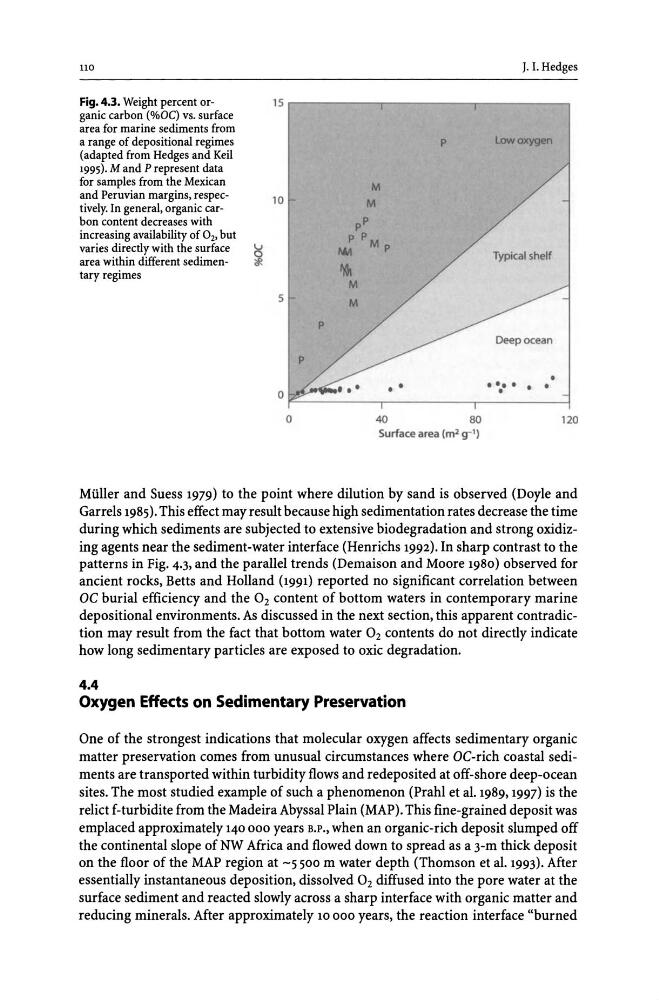
Fig. 4.3. Weight percent organic carbon (%OC) vs. surface
area for marine sediments from
a range of depositional regimes
(adapted from Hedges and Keil
1995). M and P represent data
for samples from the Mexican
and Peruvian margins, respectively. In general, organic carbon content decreases with
increasing availability of O2, but
varies directly with the surface
area within different sedimentary regimes
~
J.I. Hedges
15 rl------~----,_------------~----------__,
10
5
p
p
M
M
pP
p p
MJI
M P
' lO!
M
M
p
Low oxygen
Typical shelf
Deep ocean
o r:--_. · ·
..... ·
l
o
40
80
120
Surface area (m2 g-I )
Muller and Suess 1979) to the point where dilution by sand is observed (Doyle and
Garrels 1985). This effect may result because high sedimentation rates decrease the time
during which sediments are subjected to extensive biodegradation and strong oxidizing agents near the sediment-water interface (Henrichs 1992). In sharp contrast to the
patterns in Fig. 4.3, and the parallel trends (Demaison and Moore 1980) observed for
ancient rocks, Betts and Holland (1991) reported no significant correlation between
DC burial efficiency and the O2 content of bottom waters in contemporary marine
depositional environments. As discussed in the next section, this apparent contradiction may result from the fact that bottom water O2 contents do not directly indicate
how long sedimentary particles are exposed to oxic degradation.
4.4
Oxygen Effects on Sedimentary Preservation
One of the strongest indications that molecular oxygen affects sedimentary organic
matter preservation comes from unusual circumstances where DC-rich coastal sediments are transported within turbidity flows and redeposited at off-shore deep-ocean
sites. The most studied example of such a phenomenon (Prahl et al. 1989, 1997) is the
relict f-turbidite from the Madeira Abyssal Plain (MAP). This fine-grained deposit was
emplaced approximately 140 000 years B.P., when an organic-rich deposit slumped off
the continental slope of NW Africa and flowed down to spread as a 3-m thick deposit
on the floor of the MAP region at -5500 m water depth (Thomson et al. 1993). After
essentially instantaneous deposition, dissolved O 2 diffused into the pore water at the
surface sediment and reacted slowly across a sharp interface with organic matter and
reducing minerals. After approximately 10 000 years, the reaction interface "burned
Fig. 4.3. Weight percent organic carbon (%OC) vs. surface
area for marine sediments from
a range of depositional regimes
(adapted from Hedges and Keil
1995). M and P represent data
for samples from the Mexican
and Peruvian margins, respectively. In general, organic carbon content decreases with
increasing availability of O2, but
varies directly with the surface
area within different sedimentary regimes
~
J.I. Hedges
15 rl------~----,_------------~----------__,
10
5
p
p
M
M
pP
p p
MJI
M P
' lO!
M
M
p
Low oxygen
Typical shelf
Deep ocean
o r:--_. · ·
..... ·
l
o
40
80
120
Surface area (m2 g-I )
Muller and Suess 1979) to the point where dilution by sand is observed (Doyle and
Garrels 1985). This effect may result because high sedimentation rates decrease the time
during which sediments are subjected to extensive biodegradation and strong oxidizing agents near the sediment-water interface (Henrichs 1992). In sharp contrast to the
patterns in Fig. 4.3, and the parallel trends (Demaison and Moore 1980) observed for
ancient rocks, Betts and Holland (1991) reported no significant correlation between
DC burial efficiency and the O2 content of bottom waters in contemporary marine
depositional environments. As discussed in the next section, this apparent contradiction may result from the fact that bottom water O2 contents do not directly indicate
how long sedimentary particles are exposed to oxic degradation.
4.4
Oxygen Effects on Sedimentary Preservation
One of the strongest indications that molecular oxygen affects sedimentary organic
matter preservation comes from unusual circumstances where DC-rich coastal sediments are transported within turbidity flows and redeposited at off-shore deep-ocean
sites. The most studied example of such a phenomenon (Prahl et al. 1989, 1997) is the
relict f-turbidite from the Madeira Abyssal Plain (MAP). This fine-grained deposit was
emplaced approximately 140 000 years B.P., when an organic-rich deposit slumped off
the continental slope of NW Africa and flowed down to spread as a 3-m thick deposit
on the floor of the MAP region at -5500 m water depth (Thomson et al. 1993). After
essentially instantaneous deposition, dissolved O 2 diffused into the pore water at the
surface sediment and reacted slowly across a sharp interface with organic matter and
reducing minerals. After approximately 10 000 years, the reaction interface "burned