

CHAPTER 3 . Photochemical Processes in the Euphotic Zone of Sea Water
101
phenol, in the presence of iron(III) and halide ions gives the formation of halogenated
phenols.
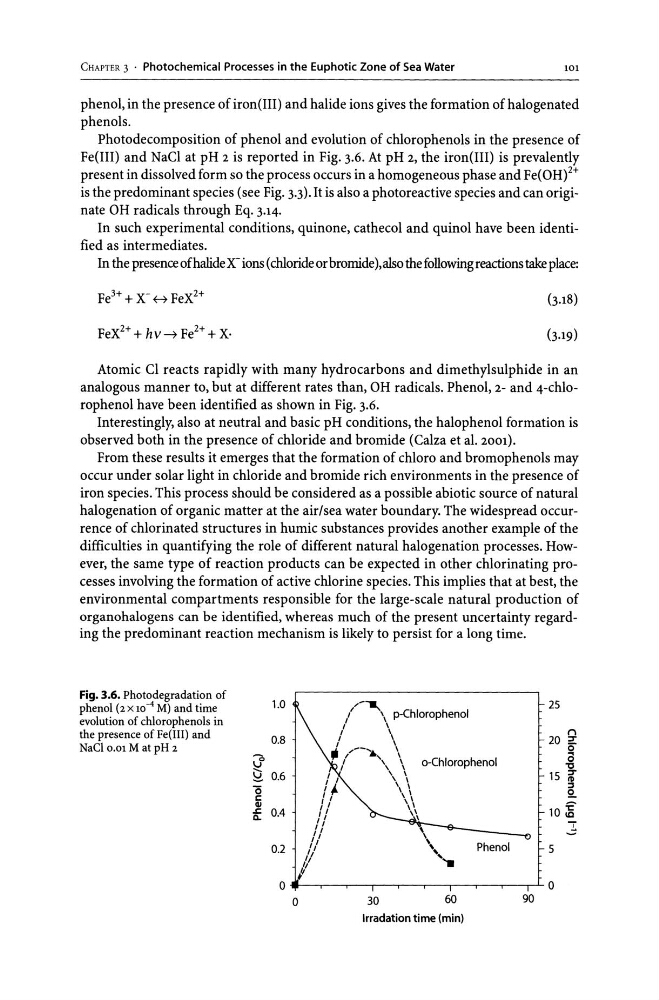
Photodecomposition of phenol and evolution of chlorophenols in the presence of
Fe(III) and NaCI at pH 2 is reported in Fig. 3.6. At pH 2, the iron(III) is prevalently
present in dissolved form so the process occurs in a homogeneous phase and Fe(OH)2+
is the predominant species (see Fig. 3.3). It is also a photoreactive species and can originate OH radicals through Eq. 3-14.
In such experimental conditions, quinone, cathecol and quinol have been identified as intermediates.
In the presence of halide X- ions (chloride or bromide ),also the following reactions take place:
Fe H + X- H FeX 2 +
(3.18)
FeX 2 + + hv~ Fe 2 + + X·
(3-19 )
Atomic CI reacts rapidly with many hydrocarbons and dimethylsulphide in an
analogous manner to, but at different rates than, OH radicals. Phenol, 2- and 4-chlorophenol have been identified as shown in Fig. 3.6.
Interestingly, also at neutral and basic pH conditions, the halophenol formation is
observed both in the presence of chloride and bromide (Calza et al. 2001).
From these results it emerges that the formation of chloro and bromophenols may
occur under solar light in chloride and bromide rich environments in the presence of
iron species. This process should be considered as a possible abiotic source of natural
halogenation of organic matter at the air/sea water boundary. The widespread occurrence of chlorinated structures in humic substances provides another example of the
difficulties in quantifying the role of different natural halogenation processes. However, the same type of reaction products can be expected in other chlorinating processes involving the formation of active chlorine species. This implies that at best, the
environmental compartments responsible for the large-scale natural production of
organohalogens can be identified, whereas much of the present uncertainty regarding the predominant reaction mechanism is likely to persist for a long time.
Fig. 3.6. Photo degradation of
1.0
/"----, p-Chlorophenol
phenol (2 x 10 -4 M) and tim:
evolution of chlorophenols In
I
,
I
\
I
\
the presence of Fe(III) and
0.8
I
\
NaCI 0.01 M at pH 2
J'
_ .... --..... \
/
' , \ o-Chlorophenol
g. 0.6
I
\ \
I I
, \
"0
f I\ \
c
: /
\ \
GI
II
\\
..r:: 0.4
0..
J I
\
II
,
I I
\
0.2
II
\
Phenol
II
' ...
/."
l
20 2 o
~
15 if
::I
210 ~
25
5
o •
0
o
30
60
90
Irradation time (min)
101
phenol, in the presence of iron(III) and halide ions gives the formation of halogenated
phenols.
Photodecomposition of phenol and evolution of chlorophenols in the presence of
Fe(III) and NaCI at pH 2 is reported in Fig. 3.6. At pH 2, the iron(III) is prevalently
present in dissolved form so the process occurs in a homogeneous phase and Fe(OH)2+
is the predominant species (see Fig. 3.3). It is also a photoreactive species and can originate OH radicals through Eq. 3-14.
In such experimental conditions, quinone, cathecol and quinol have been identified as intermediates.
In the presence of halide X- ions (chloride or bromide ),also the following reactions take place:
Fe H + X- H FeX 2 +
(3.18)
FeX 2 + + hv~ Fe 2 + + X·
(3-19 )
Atomic CI reacts rapidly with many hydrocarbons and dimethylsulphide in an
analogous manner to, but at different rates than, OH radicals. Phenol, 2- and 4-chlorophenol have been identified as shown in Fig. 3.6.
Interestingly, also at neutral and basic pH conditions, the halophenol formation is
observed both in the presence of chloride and bromide (Calza et al. 2001).
From these results it emerges that the formation of chloro and bromophenols may
occur under solar light in chloride and bromide rich environments in the presence of
iron species. This process should be considered as a possible abiotic source of natural
halogenation of organic matter at the air/sea water boundary. The widespread occurrence of chlorinated structures in humic substances provides another example of the
difficulties in quantifying the role of different natural halogenation processes. However, the same type of reaction products can be expected in other chlorinating processes involving the formation of active chlorine species. This implies that at best, the
environmental compartments responsible for the large-scale natural production of
organohalogens can be identified, whereas much of the present uncertainty regarding the predominant reaction mechanism is likely to persist for a long time.
Fig. 3.6. Photo degradation of
1.0
/"----, p-Chlorophenol
phenol (2 x 10 -4 M) and tim:
evolution of chlorophenols In
I
,
I
\
I
\
the presence of Fe(III) and
0.8
I
\
NaCI 0.01 M at pH 2
J'
_ .... --..... \
/
' , \ o-Chlorophenol
g. 0.6
I
\ \
I I
, \
"0
f I\ \
c
: /
\ \
GI
II
\\
..r:: 0.4
0..
J I
\
II
,
I I
\
0.2
II
\
Phenol
II
' ...
/."
l
20 2 o
~
15 if
::I
210 ~
25
5
o •
0
o
30
60
90
Irradation time (min)