

100
E. Pelizzetti . P. Calza
ied. Behnke et al. (1995) have produced, for example, chlorine during irradiation of most
metal-oxide aerosol (Ti0 2 , Fe20 3 and Si0 2 ) in the presence of HCI and 03' The authors
postulate a photocatalytic mechanism involving electron transfer and free-radical
reactions to explain these observations.
Recently, we have observed that photocatalytic transformation of trichloromethane
on titanium dioxide was inhibited by chloride and that tetrachlorometane is formed
during the process (Minero et al.I997). The suggested mechanism involves the oxidation of chloride through reaction with the valence band holes, according to:
htB+cr ~·CI
(3.17)
and subsequent reaction of ·CI with ·CCI3.
Several oxides and chalcogenides that occur in the environment can be activated
by absorption of ground-level solar light, such as widely diffuse iron oxides. Fe203 is a
semiconductor widely diffuse in nature and the photocatalytic halogenation with Fe203
may represent an important natural source of halogenated compounds in the environment.
The influence of iron (III) on the photoinduced transformations of phenol in the
presence of halides can be adopted as a model system. The photodecomposition of
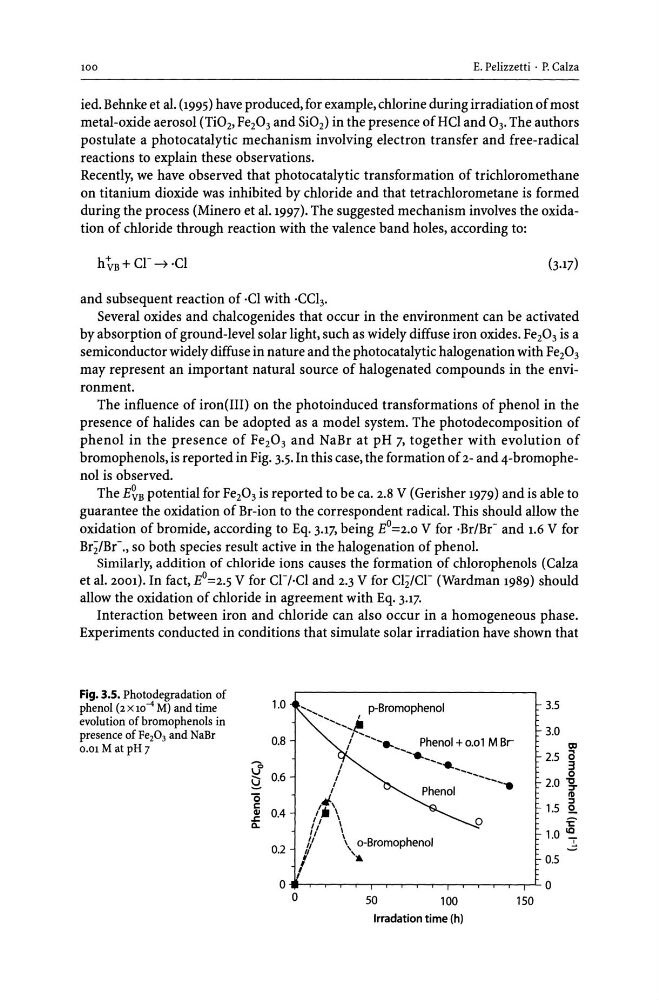
phenol in the presence of Fe203 and NaBr at pH 7, together with evolution of
bromophenols, is reported in Fig. 3.5. In this case, the formation of 2- and 4-bromophenol is observed.
The E~B potential for Fe203 is reported to be ca. 2.8 V (Gerisher 1979) and is able to
guarantee the oxidation of Br-ion to the correspondent radical. This should allow the
oxidation of bromide, according to Eq. 3.17, being EO=2.0 V for ·Br/Br- and 1.6 V for
Brz/Br-., so both species result active in the halogenation of phenol.
Similarly, addition of chloride ions causes the formation of chlorophenols (Calza
et al. 2001). In fact, EO=2.5 V for Cr/·CI and 2.3 V for CI2/Cr (Wardman 1989) should
allow the oxidation of chloride in agreement with Eq. 3-17.
Interaction between iron and chloride can also occur in a homogeneous phase.
Experiments conducted in conditions that simulate solar irradiation have shown that
Fig. 3.5. Photodegradation of
phenol (2 x 10- 4 M) and time
evolution of bromophenols in
presence of Fe203 and NaBr
0.01 M at pH 7
1.0
0.8
3' Q 0.6
'0
c:
cu 0.4
..c:
c..
0.2
'"
p-Bromophenol
.......................... ~
, "
/
""'"
Phenol + 0.01 M Br
,
,
/
1*\
I. \
'I
\
" \
' . . , "'"
I,
\
£'
\ o-Bromophenol
II
,
I
It..
I
" "
"""
3.5
3.0
OJ
2.5 a
~
2.0 }
1.5 [
i:
1.0 IQ
.}
0.5
o. o
0
50
100
150
Irradation time (h)
E. Pelizzetti . P. Calza
ied. Behnke et al. (1995) have produced, for example, chlorine during irradiation of most
metal-oxide aerosol (Ti0 2 , Fe20 3 and Si0 2 ) in the presence of HCI and 03' The authors
postulate a photocatalytic mechanism involving electron transfer and free-radical
reactions to explain these observations.
Recently, we have observed that photocatalytic transformation of trichloromethane
on titanium dioxide was inhibited by chloride and that tetrachlorometane is formed
during the process (Minero et al.I997). The suggested mechanism involves the oxidation of chloride through reaction with the valence band holes, according to:
htB+cr ~·CI
(3.17)
and subsequent reaction of ·CI with ·CCI3.
Several oxides and chalcogenides that occur in the environment can be activated
by absorption of ground-level solar light, such as widely diffuse iron oxides. Fe203 is a
semiconductor widely diffuse in nature and the photocatalytic halogenation with Fe203
may represent an important natural source of halogenated compounds in the environment.
The influence of iron (III) on the photoinduced transformations of phenol in the
presence of halides can be adopted as a model system. The photodecomposition of
phenol in the presence of Fe203 and NaBr at pH 7, together with evolution of
bromophenols, is reported in Fig. 3.5. In this case, the formation of 2- and 4-bromophenol is observed.
The E~B potential for Fe203 is reported to be ca. 2.8 V (Gerisher 1979) and is able to
guarantee the oxidation of Br-ion to the correspondent radical. This should allow the
oxidation of bromide, according to Eq. 3.17, being EO=2.0 V for ·Br/Br- and 1.6 V for
Brz/Br-., so both species result active in the halogenation of phenol.
Similarly, addition of chloride ions causes the formation of chlorophenols (Calza
et al. 2001). In fact, EO=2.5 V for Cr/·CI and 2.3 V for CI2/Cr (Wardman 1989) should
allow the oxidation of chloride in agreement with Eq. 3-17.
Interaction between iron and chloride can also occur in a homogeneous phase.
Experiments conducted in conditions that simulate solar irradiation have shown that
Fig. 3.5. Photodegradation of
phenol (2 x 10- 4 M) and time
evolution of bromophenols in
presence of Fe203 and NaBr
0.01 M at pH 7
1.0
0.8
3' Q 0.6
'0
c:
cu 0.4
..c:
c..
0.2
'"
p-Bromophenol
.......................... ~
, "
/
""'"
Phenol + 0.01 M Br
,
,
/
1*\
I. \
'I
\
" \
' . . , "'"
I,
\
£'
\ o-Bromophenol
II
,
I
It..
I
" "
"""
3.5
3.0
OJ
2.5 a
~
2.0 }
1.5 [
i:
1.0 IQ
.}
0.5
o. o
0
50
100
150
Irradation time (h)