

768
3
Chemical Glycosylation Reactions
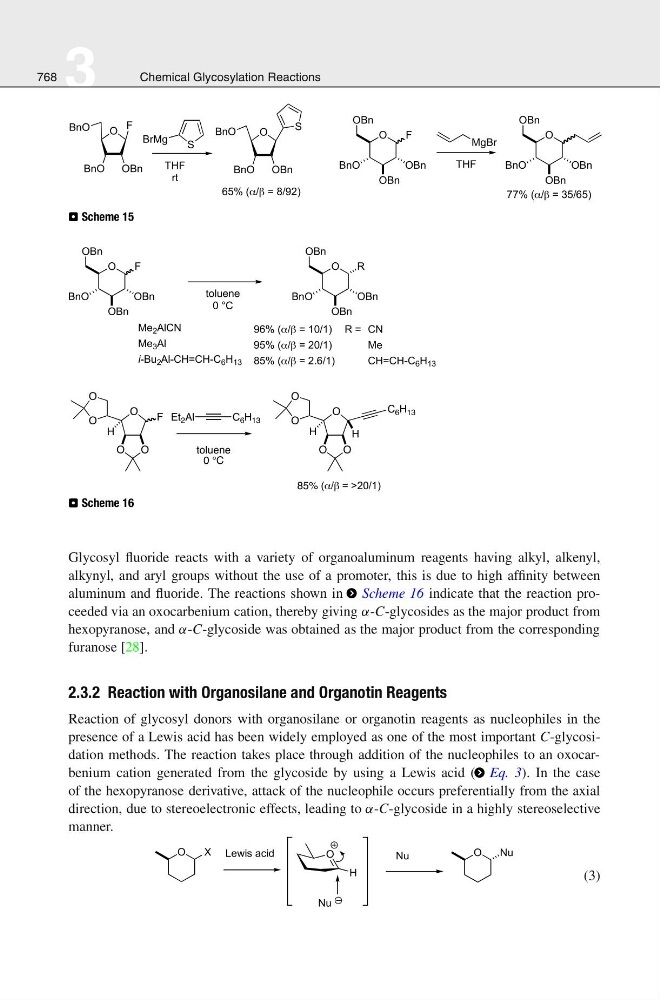
⊡ Scheme 15
⊡ Scheme 16
Glycosyl fluoride reacts with a variety of organoaluminum reagents having alkyl, alkenyl,
alkynyl, and aryl groups without the use of a promoter, this is due to high affinity between
aluminum and fluoride. The reactions shown in > Scheme 16 indicate that the reaction proceeded via an oxocarbenium cation, thereby giving α-C-glycosides as the major product from
hexopyranose, and α-C-glycoside was obtained as the major product from the corresponding
furanose [28].
2.3.2 Reaction with Organosilane and Organotin Reagents
Reaction of glycosyl donors with organosilane or organotin reagents as nucleophiles in the
presence of a Lewis acid has been widely employed as one of the most important C-glycosidation methods. The reaction takes place through addition of the nucleophiles to an oxocarbenium cation generated from the glycoside by using a Lewis acid ( > Eq. 3). In the case
of the hexopyranose derivative, attack of the nucleophile occurs preferentially from the axial
direction, due to stereoelectronic effects, leading to α-C-glycoside in a highly stereoselective
manner.
(3)