

C-Glycosylation
3.8
769
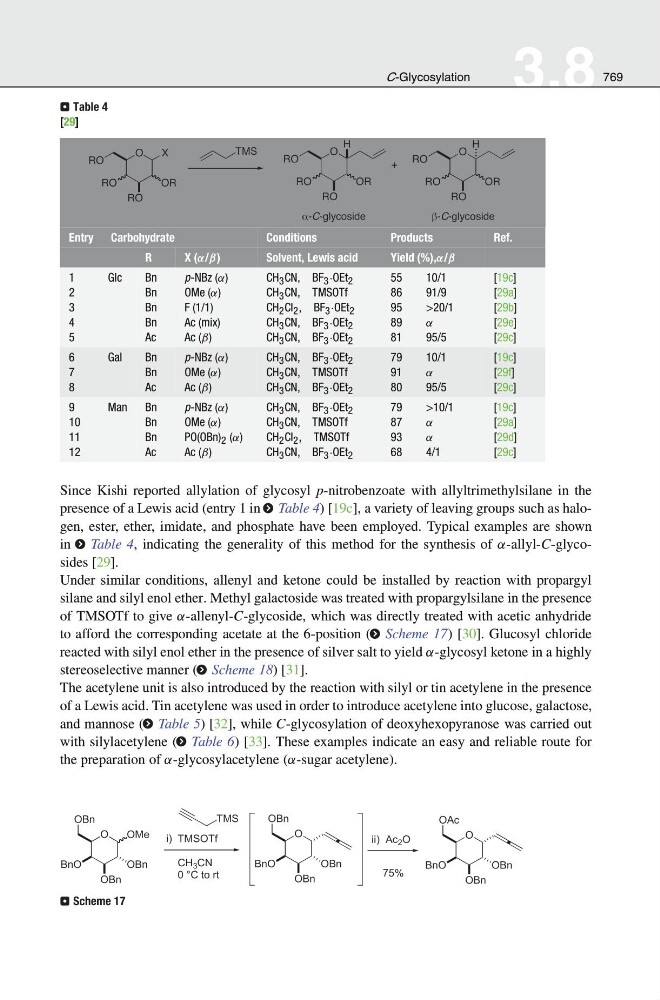
⊡ Table 4
[29]
Entry Carbohydrate
Conditions
Products
Ref.
R
X (α/β)
Solvent, Lewis acid
Yield (%),α/β
1
2
3
4
5
Glc
Bn
Bn
Bn
Bn
Ac
p-NBz (α)
OMe (α)
F (1/1)
Ac (mix)
Ac (β)
CH 3 CN, BF 3 ·OEt 2
CH 3 CN, TMSOTf
CH 2 Cl 2 , BF 3 ·OEt 2
CH 3 CN, BF 3 ·OEt 2
CH 3 CN, BF 3 ·OEt 2
55
10/1
86
91/9
95
>20/1
89
α
81
95/5
[19c]
[29a]
[29b]
[29e]
[29c]
6
7
8
Gal
Bn
Bn
Ac
p-NBz (α)
OMe (α)
Ac (β)
CH 3 CN, BF 3 ·OEt 2
CH 3 CN, TMSOTf
CH 3 CN, BF 3 ·OEt 2
79
10/1
91
α
80
95/5
[19c]
[29f]
[29c]
9
10
11
12
Man
Bn
Bn
Bn
Ac
p-NBz (α)
OMe (α)
PO(OBn) 2 (α)
Ac (β)
CH 3 CN, BF 3 ·OEt 2
CH 3 CN, TMSOTf
CH 2 Cl 2 , TMSOTf
CH 3 CN, BF 3 ·OEt 2
79
>10/1
87
α
93
α
68
4/1
[19c]
[29a]
[29d]
[29c]
Since Kishi reported allylation of glycosyl p-nitrobenzoate with allyltrimethylsilane in the
presence of a Lewis acid (entry 1 in > Table 4) [19c], a variety of leaving groups such as halogen, ester, ether, imidate, and phosphate have been employed. Typical examples are shown
in > Table 4, indicating the generality of this method for the synthesis of α-allyl-C-glycosides [29].
Under similar conditions, allenyl and ketone could be installed by reaction with propargyl
silane and silyl enol ether. Methyl galactoside was treated with propargylsilane in the presence
of TMSOTf to give α-allenyl-C-glycoside, which was directly treated with acetic anhydride
to afford the corresponding acetate at the 6-position ( > Scheme 17) [30]. Glucosyl chloride
reacted with silyl enol ether in the presence of silver salt to yield α-glycosyl ketone in a highly
stereoselective manner ( > Scheme 18) [31].
The acetylene unit is also introduced by the reaction with silyl or tin acetylene in the presence
of a Lewis acid. Tin acetylene was used in order to introduce acetylene into glucose, galactose,
and mannose ( > Table 5) [32], while C-glycosylation of deoxyhexopyranose was carried out
with silylacetylene ( > Table 6) [33]. These examples indicate an easy and reliable route for
the preparation of α-glycosylacetylene (α-sugar acetylene).
⊡ Scheme 17