

C-Glycosylation
3.8
767
the glycoside upon reaction with Lewis acid. In the latter case, the stereochemistry of the addition is controlled by steric hindrance and/or stereoelectronic effects. This section deals with
these types of reactions classified by nucleophiles such as (i) Grignard reagents and organoaluminum reagents, (ii) organosilane and tin reagents, (iii) aromatic nucleophiles (for Friedel–
Crafts reaction).
2.3.1 Reaction with Grignard Reagents and Organoaluminum Reagents
Addition of a Grignard reagent to glycosyl halide has been employed as one of the classic
methods for C-glycoside synthesis. However, the use of this method is limited to the reaction
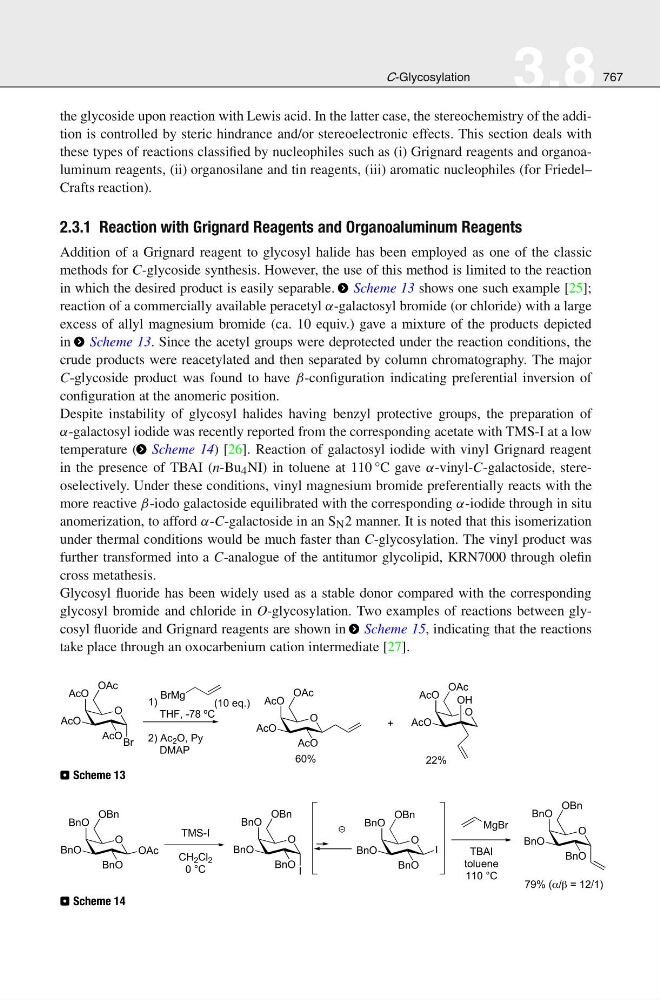
in which the desired product is easily separable. > Scheme 13 shows one such example [25];
reaction of a commercially available peracetyl α-galactosyl bromide (or chloride) with a large
excess of allyl magnesium bromide (ca. 10 equiv.) gave a mixture of the products depicted
in > Scheme 13. Since the acetyl groups were deprotected under the reaction conditions, the
crude products were reacetylated and then separated by column chromatography. The major
C-glycoside product was found to have β-configuration indicating preferential inversion of
configuration at the anomeric position.
Despite instability of glycosyl halides having benzyl protective groups, the preparation of
α-galactosyl iodide was recently reported from the corresponding acetate with TMS-I at a low
temperature ( > Scheme 14) [26]. Reaction of galactosyl iodide with vinyl Grignard reagent
in the presence of TBAI (n-Bu 4 NI) in toluene at 110 °C gave α-vinyl-C-galactoside, stereoselectively. Under these conditions, vinyl magnesium bromide preferentially reacts with the
more reactive β-iodo galactoside equilibrated with the corresponding α-iodide through in situ
anomerization, to afford α-C-galactoside in an S N 2 manner. It is noted that this isomerization
under thermal conditions would be much faster than C-glycosylation. The vinyl product was
further transformed into a C-analogue of the antitumor glycolipid, KRN7000 through olefin
cross metathesis.
Glycosyl fluoride has been widely used as a stable donor compared with the corresponding
glycosyl bromide and chloride in O-glycosylation. Two examples of reactions between glycosyl fluoride and Grignard reagents are shown in > Scheme 15, indicating that the reactions
take place through an oxocarbenium cation intermediate [27].
⊡ Scheme 13
⊡ Scheme 14