

766
3
Chemical Glycosylation Reactions
⊡ Table 3
[23]
Entry Furanolactone
Nucleophiles
Hemiacetal Product
Ref.
Yield (α/β)
1
MeLi
ND
53% (100/0)* [23a]
2
ND
81% (5/1)*
[23a]
3
LiCH 2 PO(OMe) 2
93%
95% (100/0)
[23b]
4
MeLi
81%
76% (1/5)
[23a]
5
ND
87% (0/100)* [23c]
6
ND
72% (0/100)* [23c]
*: yield over 2 steps
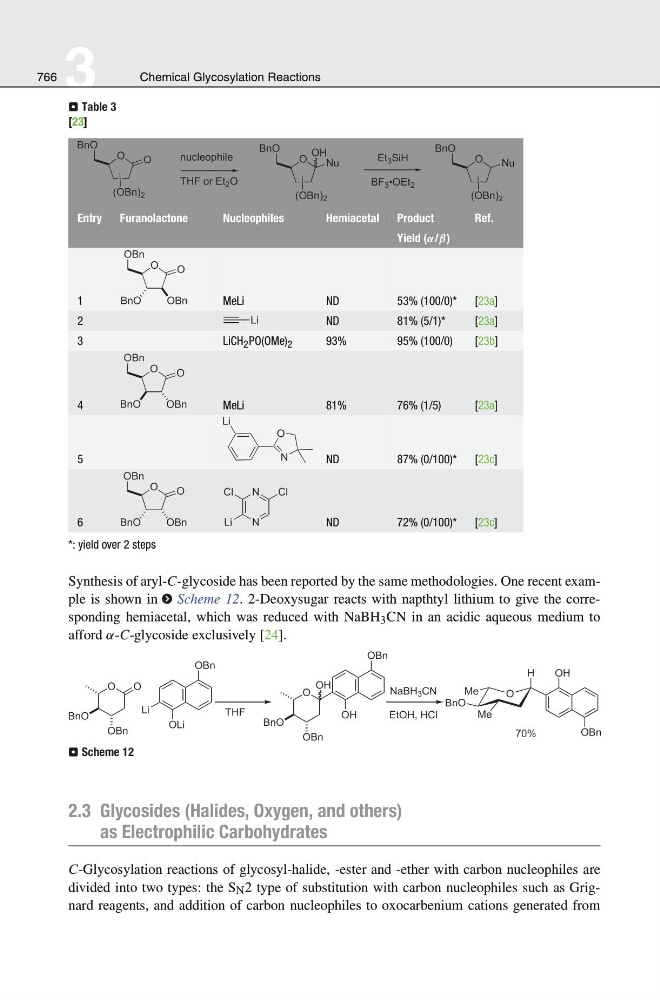
Synthesis of aryl-C-glycoside has been reported by the same methodologies. One recent example is shown in > Scheme 12. 2-Deoxysugar reacts with napthtyl lithium to give the corresponding hemiacetal, which was reduced with NaBH 3 CN in an acidic aqueous medium to
afford α-C-glycoside exclusively [24].
⊡ Scheme 12
2.3 Glycosides (Halides, Oxygen, and others)
as Electrophilic Carbohydrates
C-Glycosylation reactions of glycosyl-halide, -ester and -ether with carbon nucleophiles are
divided into two types: the S N 2 type of substitution with carbon nucleophiles such as Grignard reagents, and addition of carbon nucleophiles to oxocarbenium cations generated from
3
Chemical Glycosylation Reactions
⊡ Table 3
[23]
Entry Furanolactone
Nucleophiles
Hemiacetal Product
Ref.
Yield (α/β)
1
MeLi
ND
53% (100/0)* [23a]
2
ND
81% (5/1)*
[23a]
3
LiCH 2 PO(OMe) 2
93%
95% (100/0)
[23b]
4
MeLi
81%
76% (1/5)
[23a]
5
ND
87% (0/100)* [23c]
6
ND
72% (0/100)* [23c]
*: yield over 2 steps
Synthesis of aryl-C-glycoside has been reported by the same methodologies. One recent example is shown in > Scheme 12. 2-Deoxysugar reacts with napthtyl lithium to give the corresponding hemiacetal, which was reduced with NaBH 3 CN in an acidic aqueous medium to
afford α-C-glycoside exclusively [24].
⊡ Scheme 12
2.3 Glycosides (Halides, Oxygen, and others)
as Electrophilic Carbohydrates
C-Glycosylation reactions of glycosyl-halide, -ester and -ether with carbon nucleophiles are
divided into two types: the S N 2 type of substitution with carbon nucleophiles such as Grignard reagents, and addition of carbon nucleophiles to oxocarbenium cations generated from