

C-Glycosylation
3.8
763
⊡ Table 1
[17]
Entry R
Reagent
Temp
Yield (%) Ref.
1
Bn
−40 to 0 °C 82
[17a]
2
Bn
Me 2 TiCp 2 (Petasis)
70 °C
94
[17b]
3
TMS
−40 to 0 °C 54
[17a]
4
MOM Me 2 TiCp 2 (Petasis)
70 °C
79
[17c]
5
TES
−78 °C
74
[17d]
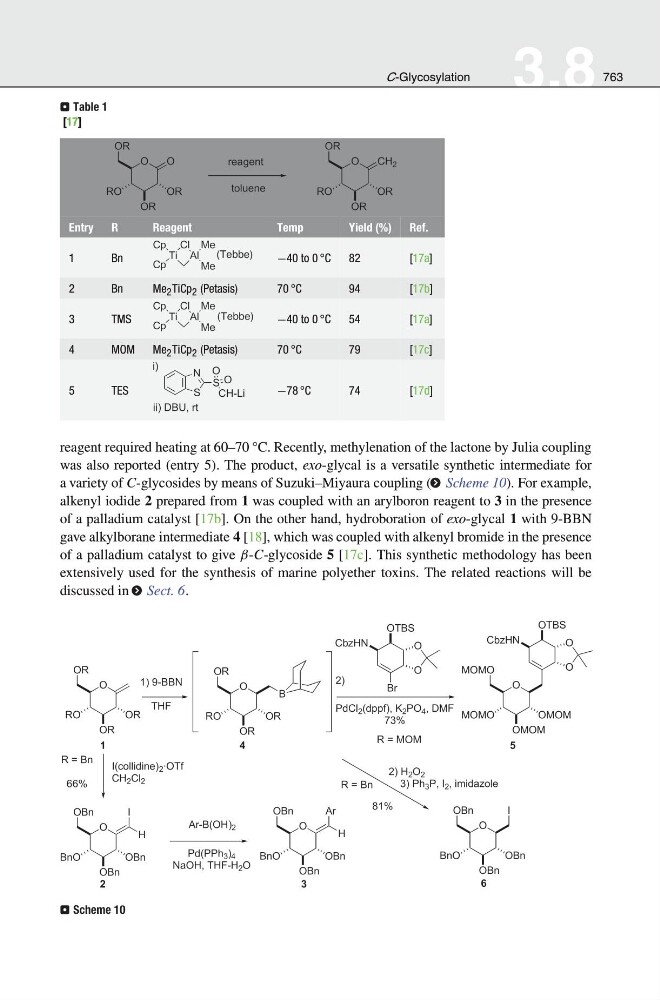
reagent required heating at 60–70 °C. Recently, methylenation of the lactone by Julia coupling
was also reported (entry 5). The product, exo-glycal is a versatile synthetic intermediate for
a variety of C-glycosides by means of Suzuki–Miyaura coupling ( > Scheme 10). For example,
alkenyl iodide 2 prepared from 1 was coupled with an arylboron reagent to 3 in the presence
of a palladium catalyst [17b]. On the other hand, hydroboration of exo-glycal 1 with 9-BBN
gave alkylborane intermediate 4 [18], which was coupled with alkenyl bromide in the presence
of a palladium catalyst to give β-C-glycoside 5 [17c]. This synthetic methodology has been
extensively used for the synthesis of marine polyether toxins. The related reactions will be
discussed in > Sect. 6.
⊡ Scheme 10