

762
3
Chemical Glycosylation Reactions
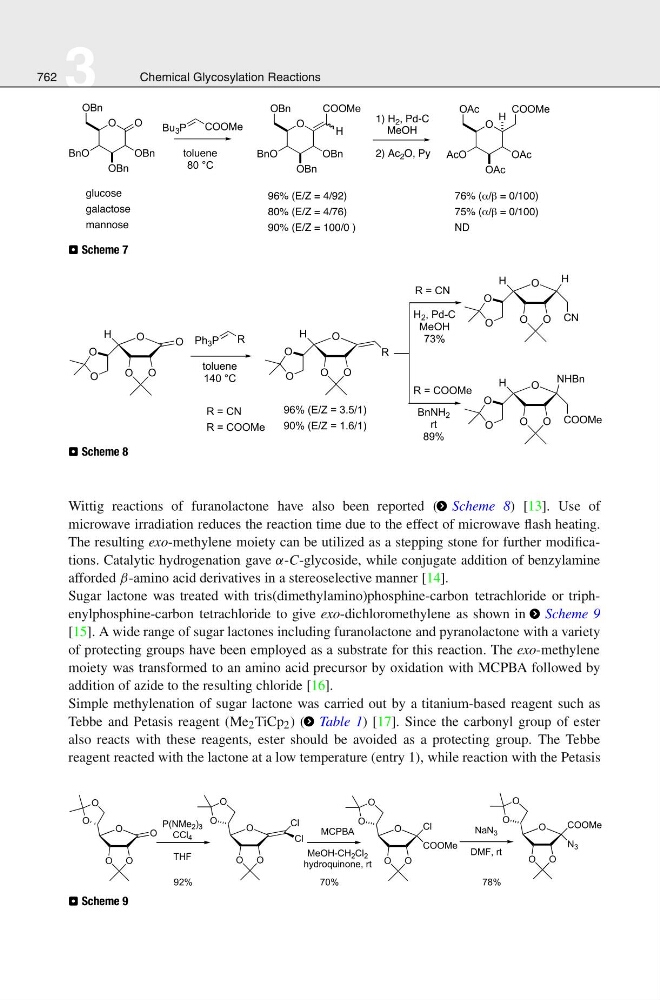
⊡ Scheme 7
⊡ Scheme 8
Wittig reactions of furanolactone have also been reported ( > Scheme 8) [13]. Use of
microwave irradiation reduces the reaction time due to the effect of microwave flash heating.
The resulting exo-methylene moiety can be utilized as a stepping stone for further modifications. Catalytic hydrogenation gave α-C-glycoside, while conjugate addition of benzylamine
afforded β-amino acid derivatives in a stereoselective manner [14].
Sugar lactone was treated with tris(dimethylamino)phosphine-carbon tetrachloride or triphenylphosphine-carbon tetrachloride to give exo-dichloromethylene as shown in > Scheme 9
[15]. A wide range of sugar lactones including furanolactone and pyranolactone with a variety
of protecting groups have been employed as a substrate for this reaction. The exo-methylene
moiety was transformed to an amino acid precursor by oxidation with MCPBA followed by
addition of azide to the resulting chloride [16].
Simple methylenation of sugar lactone was carried out by a titanium-based reagent such as
Tebbe and Petasis reagent (Me 2 TiCp 2 ) ( > Table 1) [17]. Since the carbonyl group of ester
also reacts with these reagents, ester should be avoided as a protecting group. The Tebbe
reagent reacted with the lactone at a low temperature (entry 1), while reaction with the Petasis
⊡ Scheme 9