

C-Glycosylation
3.8
761
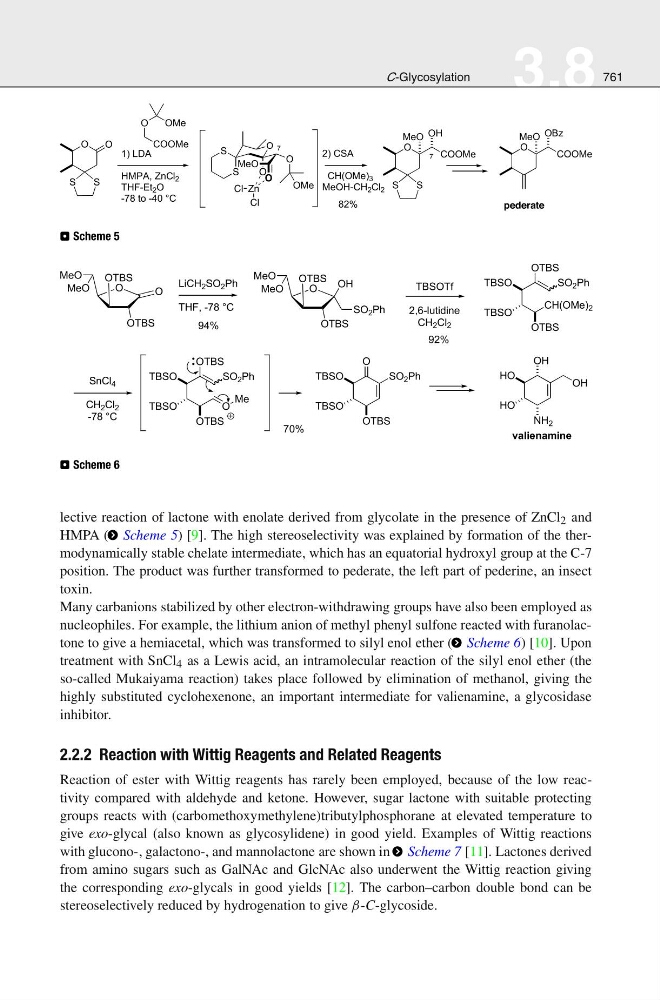
⊡ Scheme 5
⊡ Scheme 6
lective reaction of lactone with enolate derived from glycolate in the presence of ZnCl 2 and
HMPA ( > Scheme 5) [9]. The high stereoselectivity was explained by formation of the thermodynamically stable chelate intermediate, which has an equatorial hydroxyl group at the C-7
position. The product was further transformed to pederate, the left part of pederine, an insect
toxin.
Many carbanions stabilized by other electron-withdrawing groups have also been employed as
nucleophiles. For example, the lithium anion of methyl phenyl sulfone reacted with furanolactone to give a hemiacetal, which was transformed to silyl enol ether ( > Scheme 6) [10]. Upon
treatment with SnCl 4 as a Lewis acid, an intramolecular reaction of the silyl enol ether (the
so-called Mukaiyama reaction) takes place followed by elimination of methanol, giving the
highly substituted cyclohexenone, an important intermediate for valienamine, a glycosidase
inhibitor.
2.2.2 Reaction with Wittig Reagents and Related Reagents
Reaction of ester with Wittig reagents has rarely been employed, because of the low reactivity compared with aldehyde and ketone. However, sugar lactone with suitable protecting
groups reacts with (carbomethoxymethylene)tributylphosphorane at elevated temperature to
give exo-glycal (also known as glycosylidene) in good yield. Examples of Wittig reactions
with glucono-, galactono-, and mannolactone are shown in > Scheme 7 [11]. Lactones derived
from amino sugars such as GalNAc and GlcNAc also underwent the Wittig reaction giving
the corresponding exo-glycals in good yields [12]. The carbon–carbon double bond can be
stereoselectively reduced by hydrogenation to give β-C-glycoside.