

760
3
Chemical Glycosylation Reactions
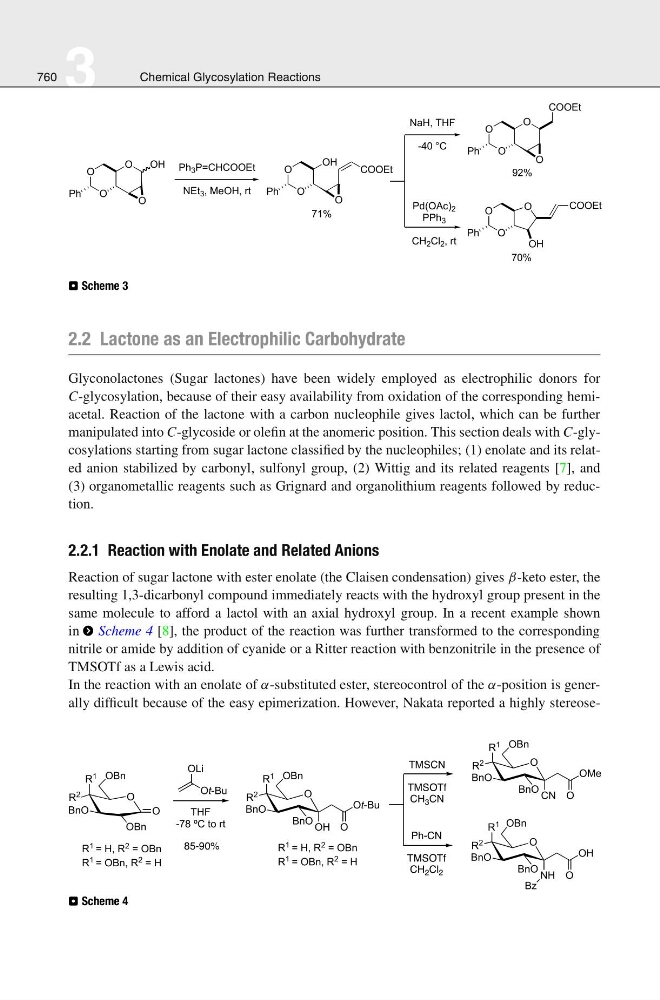
⊡ Scheme 3
2.2 Lactone as an Electrophilic Carbohydrate
Glyconolactones (Sugar lactones) have been widely employed as electrophilic donors for
C-glycosylation, because of their easy availability from oxidation of the corresponding hemiacetal. Reaction of the lactone with a carbon nucleophile gives lactol, which can be further
manipulated into C-glycoside or olefin at the anomeric position. This section deals with C-glycosylations starting from sugar lactone classified by the nucleophiles; (1) enolate and its related anion stabilized by carbonyl, sulfonyl group, (2) Wittig and its related reagents [7], and
(3) organometallic reagents such as Grignard and organolithium reagents followed by reduction.
2.2.1 Reaction with Enolate and Related Anions
Reaction of sugar lactone with ester enolate (the Claisen condensation) gives β-keto ester, the
resulting 1,3-dicarbonyl compound immediately reacts with the hydroxyl group present in the
same molecule to afford a lactol with an axial hydroxyl group. In a recent example shown
in > Scheme 4 [8], the product of the reaction was further transformed to the corresponding
nitrile or amide by addition of cyanide or a Ritter reaction with benzonitrile in the presence of
TMSOTf as a Lewis acid.
In the reaction with an enolate of α-substituted ester, stereocontrol of the α-position is generally difficult because of the easy epimerization. However, Nakata reported a highly stereose⊡ Scheme 4