

C-Glycosylation
3.8
759
⊡ Scheme 1
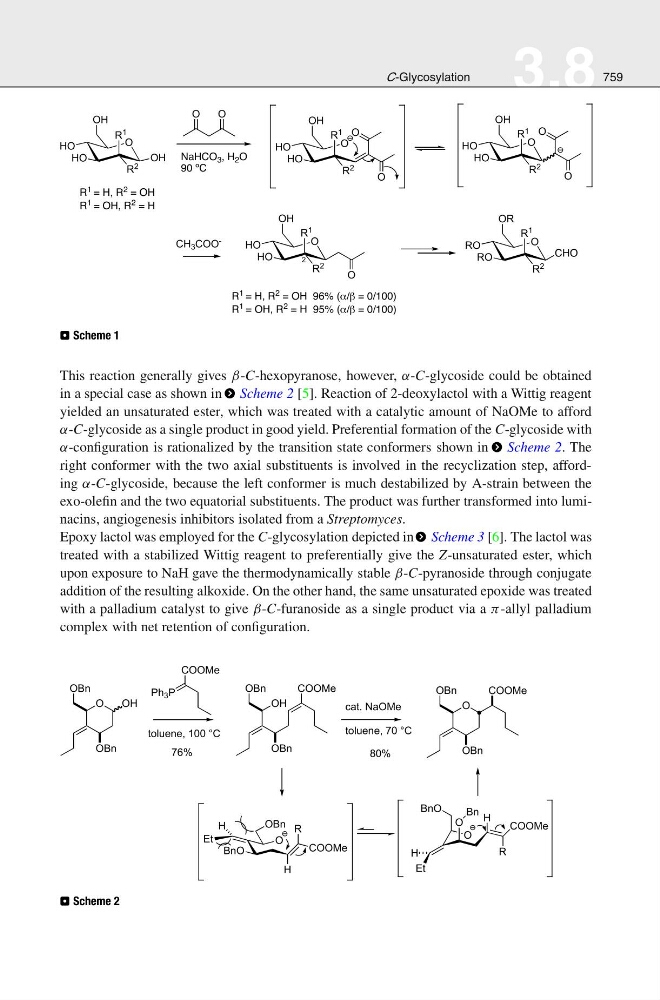
This reaction generally gives β-C-hexopyranose, however, α-C-glycoside could be obtained
in a special case as shown in > Scheme 2 [5]. Reaction of 2-deoxylactol with a Wittig reagent
yielded an unsaturated ester, which was treated with a catalytic amount of NaOMe to afford
α-C-glycoside as a single product in good yield. Preferential formation of the C-glycoside with
α-configuration is rationalized by the transition state conformers shown in > Scheme 2. The
right conformer with the two axial substituents is involved in the recyclization step, affording α-C-glycoside, because the left conformer is much destabilized by A-strain between the
exo-olefin and the two equatorial substituents. The product was further transformed into luminacins, angiogenesis inhibitors isolated from a Streptomyces.
Epoxy lactol was employed for the C-glycosylation depicted in > Scheme 3 [6]. The lactol was
treated with a stabilized Wittig reagent to preferentially give the Z-unsaturated ester, which
upon exposure to NaH gave the thermodynamically stable β-C-pyranoside through conjugate
addition of the resulting alkoxide. On the other hand, the same unsaturated epoxide was treated
with a palladium catalyst to give β-C-furanoside as a single product via a π-allyl palladium
complex with net retention of configuration.
⊡ Scheme 2