

764
3
Chemical Glycosylation Reactions
2.2.3 Reaction with Organometallic Reagents Followed by Reduction
of the Newly Formed Hemiacetal
Reaction of glyconolactone with organometallic reagents such as Grignard and organolithium
reagents gives hemiacetal (ketose). The resulting hemiacetal is reduced with Et 3 SiH in the
presence of a Lewis acid such as TMSOTf or BF 3 ·OEt 2 to afford C-glycoside ( > Eq. 2). In
the reduction of a hexopyranose intermediate, the hydride attacks the oxocarbenium cation
generated from the reaction between the hemiacetal and the Lewis acid from the axial position, because of the stereoelectronic effect, affording β-C-glycoside. This two-step procedure established by Kishi is one of the most widely used reactions for β-C-hexopyranoside
( > Table 2) [19].
(2)
As shown in > Table 2, this procedure enables the synthesis of a variety of β-C-glucosides
and β-C-galactosides with substituents such as alkyl, allyl, vinyl, alkynyl, propargyl, aromatic,
heteroaromatic [20], and acetyl groups.
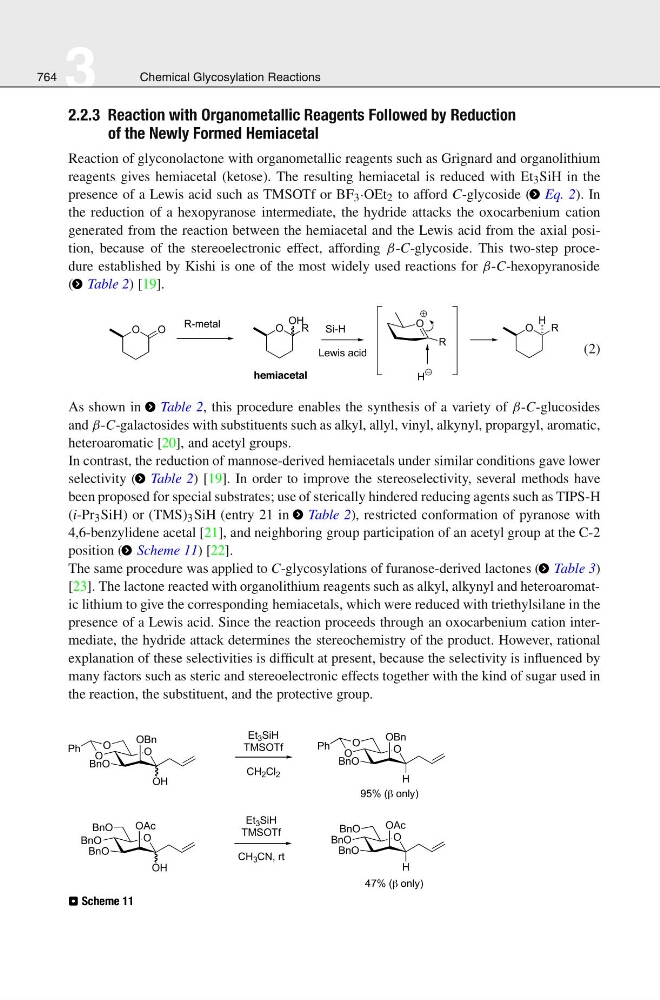
In contrast, the reduction of mannose-derived hemiacetals under similar conditions gave lower
selectivity ( > Table 2) [19]. In order to improve the stereoselectivity, several methods have
been proposed for special substrates; use of sterically hindered reducing agents such as TIPS-H
(i-Pr 3 SiH) or (TMS) 3 SiH (entry 21 in > Table 2), restricted conformation of pyranose with
4,6-benzylidene acetal [21], and neighboring group participation of an acetyl group at the C-2
position ( > Scheme 11) [22].
The same procedure was applied to C-glycosylations of furanose-derived lactones ( > Table 3)
[23]. The lactone reacted with organolithium reagents such as alkyl, alkynyl and heteroaromatic lithium to give the corresponding hemiacetals, which were reduced with triethylsilane in the
presence of a Lewis acid. Since the reaction proceeds through an oxocarbenium cation intermediate, the hydride attack determines the stereochemistry of the product. However, rational
explanation of these selectivities is difficult at present, because the selectivity is influenced by
many factors such as steric and stereoelectronic effects together with the kind of sugar used in
the reaction, the substituent, and the protective group.
⊡ Scheme 11