

Anomeric Anhydro Sugars
3.7
747
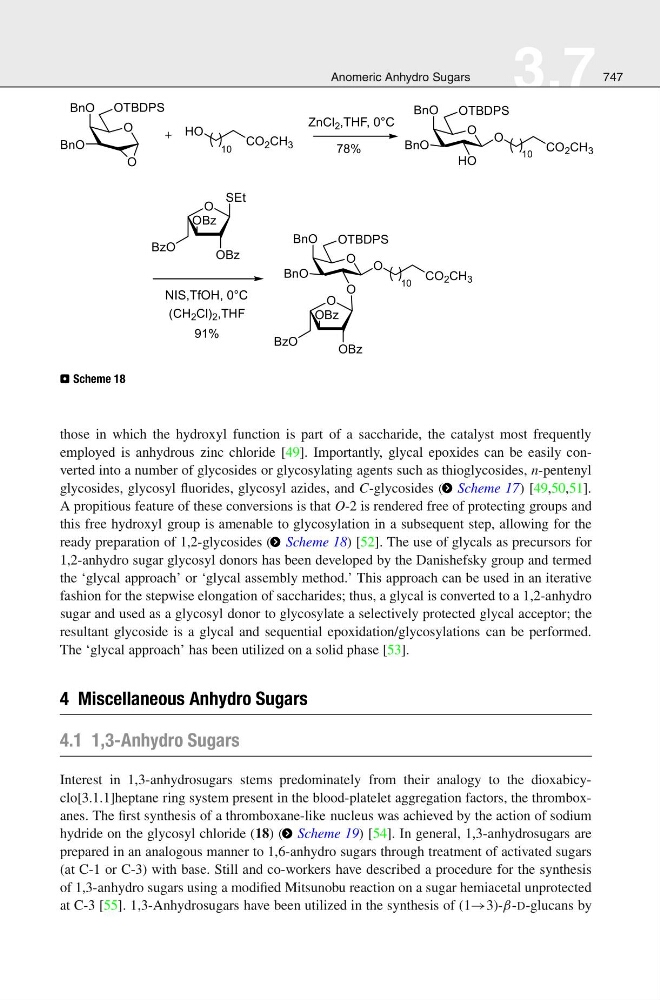
⊡ Scheme 18
those in which the hydroxyl function is part of a saccharide, the catalyst most frequently
employed is anhydrous zinc chloride [49]. Importantly, glycal epoxides can be easily converted into a number of glycosides or glycosylating agents such as thioglycosides, n-pentenyl
glycosides, glycosyl fluorides, glycosyl azides, and C-glycosides ( > Scheme 17) [49,50,51].
A propitious feature of these conversions is that O-2 is rendered free of protecting groups and
this free hydroxyl group is amenable to glycosylation in a subsequent step, allowing for the
ready preparation of 1,2-glycosides ( > Scheme 18) [52]. The use of glycals as precursors for
1,2-anhydro sugar glycosyl donors has been developed by the Danishefsky group and termed
the ‘glycal approach’ or ‘glycal assembly method.’ This approach can be used in an iterative
fashion for the stepwise elongation of saccharides; thus, a glycal is converted to a 1,2-anhydro
sugar and used as a glycosyl donor to glycosylate a selectively protected glycal acceptor; the
resultant glycoside is a glycal and sequential epoxidation/glycosylations can be performed.
The ‘glycal approach’ has been utilized on a solid phase [53].
4 Miscellaneous Anhydro Sugars
4.1 1,3-Anhydro Sugars
Interest in 1,3-anhydrosugars stems predominately from their analogy to the dioxabicyclo[3.1.1]heptane ring system present in the blood-platelet aggregation factors, the thromboxanes. The first synthesis of a thromboxane-like nucleus was achieved by the action of sodium
hydride on the glycosyl chloride (18) ( > Scheme 19) [54]. In general, 1,3-anhydrosugars are
prepared in an analogous manner to 1,6-anhydro sugars through treatment of activated sugars
(at C-1 or C-3) with base. Still and co-workers have described a procedure for the synthesis
of 1,3-anhydro sugars using a modified Mitsunobu reaction on a sugar hemiacetal unprotected
at C-3 [55]. 1,3-Anhydrosugars have been utilized in the synthesis of (1→3)-β-D-glucans by