

748
3
Chemical Glycosylation Reactions
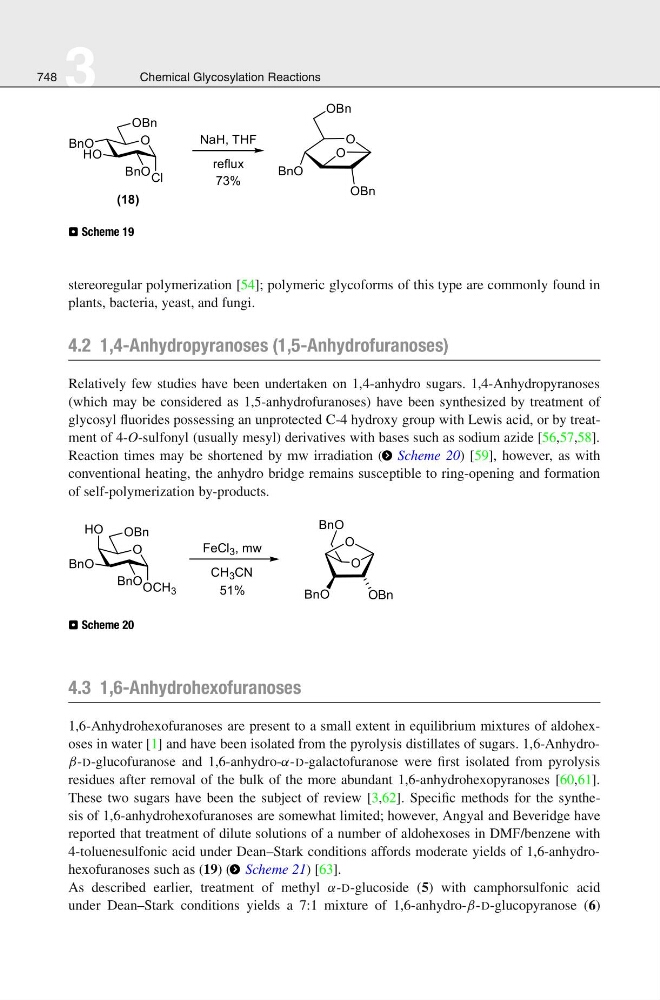
⊡ Scheme 19
stereoregular polymerization [54]; polymeric glycoforms of this type are commonly found in
plants, bacteria, yeast, and fungi.
4.2 1,4-Anhydropyranoses (1,5-Anhydrofuranoses)
Relatively few studies have been undertaken on 1,4-anhydro sugars. 1,4-Anhydropyranoses
(which may be considered as 1,5-anhydrofuranoses) have been synthesized by treatment of
glycosyl fluorides possessing an unprotected C-4 hydroxy group with Lewis acid, or by treatment of 4-O-sulfonyl (usually mesyl) derivatives with bases such as sodium azide [56,57,58].
Reaction times may be shortened by mw irradiation ( > Scheme 20) [59], however, as with
conventional heating, the anhydro bridge remains susceptible to ring-opening and formation
of self-polymerization by-products.
⊡ Scheme 20
4.3 1,6-Anhydrohexofuranoses
1,6-Anhydrohexofuranoses are present to a small extent in equilibrium mixtures of aldohexoses in water [1] and have been isolated from the pyrolysis distillates of sugars. 1,6-Anhydroβ-D-glucofuranose and 1,6-anhydro-α-D-galactofuranose were first isolated from pyrolysis
residues after removal of the bulk of the more abundant 1,6-anhydrohexopyranoses [60,61].
These two sugars have been the subject of review [3,62]. Specific methods for the synthesis of 1,6-anhydrohexofuranoses are somewhat limited; however, Angyal and Beveridge have
reported that treatment of dilute solutions of a number of aldohexoses in DMF/benzene with
4-toluenesulfonic acid under Dean–Stark conditions affords moderate yields of 1,6-anhydrohexofuranoses such as (19) ( > Scheme 21) [63].
As described earlier, treatment of methyl α-D-glucoside (5) with camphorsulfonic acid
under Dean–Stark conditions yields a 7:1 mixture of 1,6-anhydro-β-D-glucopyranose (6)