

746
3
Chemical Glycosylation Reactions
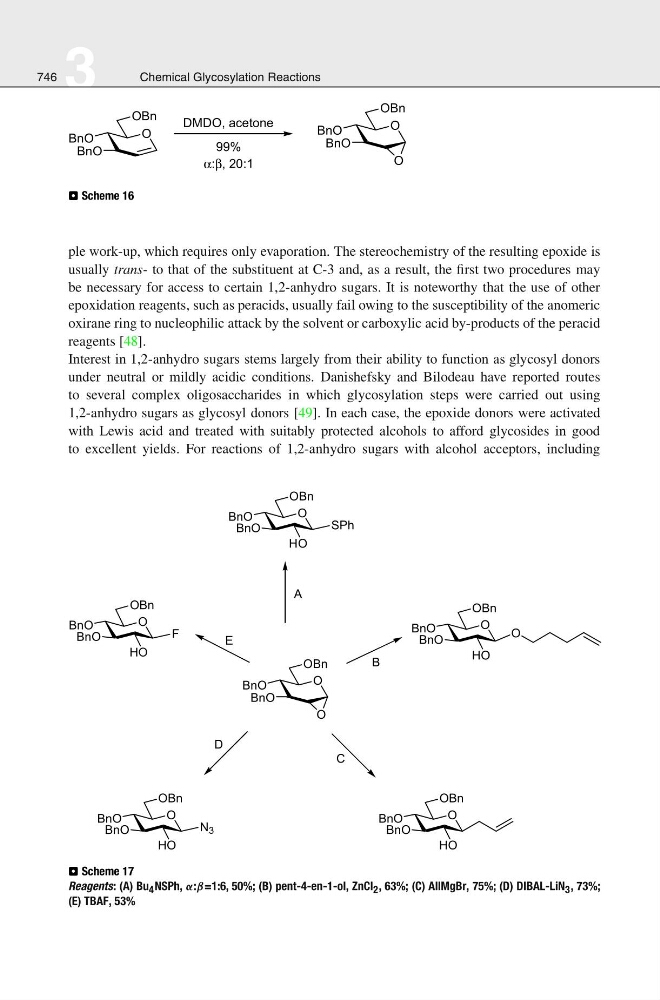
⊡ Scheme 16
ple work-up, which requires only evaporation. The stereochemistry of the resulting epoxide is
usually trans- to that of the substituent at C-3 and, as a result, the first two procedures may
be necessary for access to certain 1,2-anhydro sugars. It is noteworthy that the use of other
epoxidation reagents, such as peracids, usually fail owing to the susceptibility of the anomeric
oxirane ring to nucleophilic attack by the solvent or carboxylic acid by-products of the peracid
reagents [48].
Interest in 1,2-anhydro sugars stems largely from their ability to function as glycosyl donors
under neutral or mildly acidic conditions. Danishefsky and Bilodeau have reported routes
to several complex oligosaccharides in which glycosylation steps were carried out using
1,2-anhydro sugars as glycosyl donors [49]. In each case, the epoxide donors were activated
with Lewis acid and treated with suitably protected alcohols to afford glycosides in good
to excellent yields. For reactions of 1,2-anhydro sugars with alcohol acceptors, including
⊡ Scheme 17
Reagents: (A) Bu 4 NSPh, α:β=1:6, 50%; (B) pent-4-en-1-ol, ZnCl 2 , 63%; (C) AllMgBr, 75%; (D) DIBAL-LiN 3 , 73%;
(E) TBAF, 53%