

Anomeric Anhydro Sugars
3.7
745
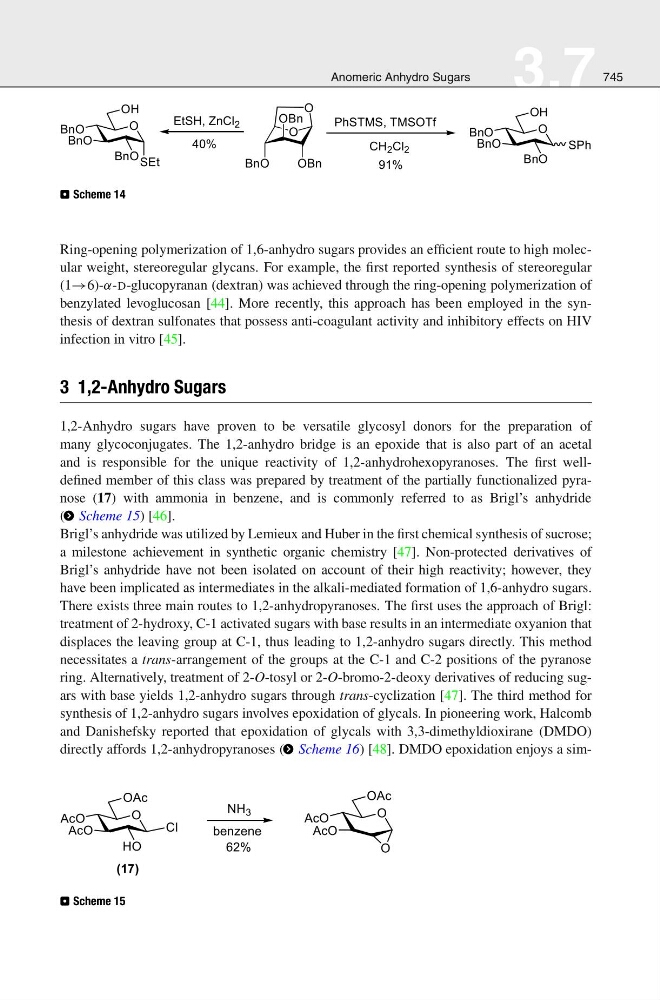
⊡ Scheme 14
Ring-opening polymerization of 1,6-anhydro sugars provides an efficient route to high molecular weight, stereoregular glycans. For example, the first reported synthesis of stereoregular
(1→6)-α-D-glucopyranan (dextran) was achieved through the ring-opening polymerization of
benzylated levoglucosan [44]. More recently, this approach has been employed in the synthesis of dextran sulfonates that possess anti-coagulant activity and inhibitory effects on HIV
infection in vitro [45].
3 1,2-Anhydro Sugars
1,2-Anhydro sugars have proven to be versatile glycosyl donors for the preparation of
many glycoconjugates. The 1,2-anhydro bridge is an epoxide that is also part of an acetal
and is responsible for the unique reactivity of 1,2-anhydrohexopyranoses. The first welldefined member of this class was prepared by treatment of the partially functionalized pyranose (17) with ammonia in benzene, and is commonly referred to as Brigl’s anhydride
( > Scheme 15) [46].
Brigl’s anhydride was utilized by Lemieux and Huber in the first chemical synthesis of sucrose;
a milestone achievement in synthetic organic chemistry [47]. Non-protected derivatives of
Brigl’s anhydride have not been isolated on account of their high reactivity; however, they
have been implicated as intermediates in the alkali-mediated formation of 1,6-anhydro sugars.
There exists three main routes to 1,2-anhydropyranoses. The first uses the approach of Brigl:
treatment of 2-hydroxy, C-1 activated sugars with base results in an intermediate oxyanion that
displaces the leaving group at C-1, thus leading to 1,2-anhydro sugars directly. This method
necessitates a trans-arrangement of the groups at the C-1 and C-2 positions of the pyranose
ring. Alternatively, treatment of 2-O-tosyl or 2-O-bromo-2-deoxy derivatives of reducing sugars with base yields 1,2-anhydro sugars through trans-cyclization [47]. The third method for
synthesis of 1,2-anhydro sugars involves epoxidation of glycals. In pioneering work, Halcomb
and Danishefsky reported that epoxidation of glycals with 3,3-dimethyldioxirane (DMDO)
directly affords 1,2-anhydropyranoses ( > Scheme 16) [48]. DMDO epoxidation enjoys a sim⊡ Scheme 15