

744
3
Chemical Glycosylation Reactions
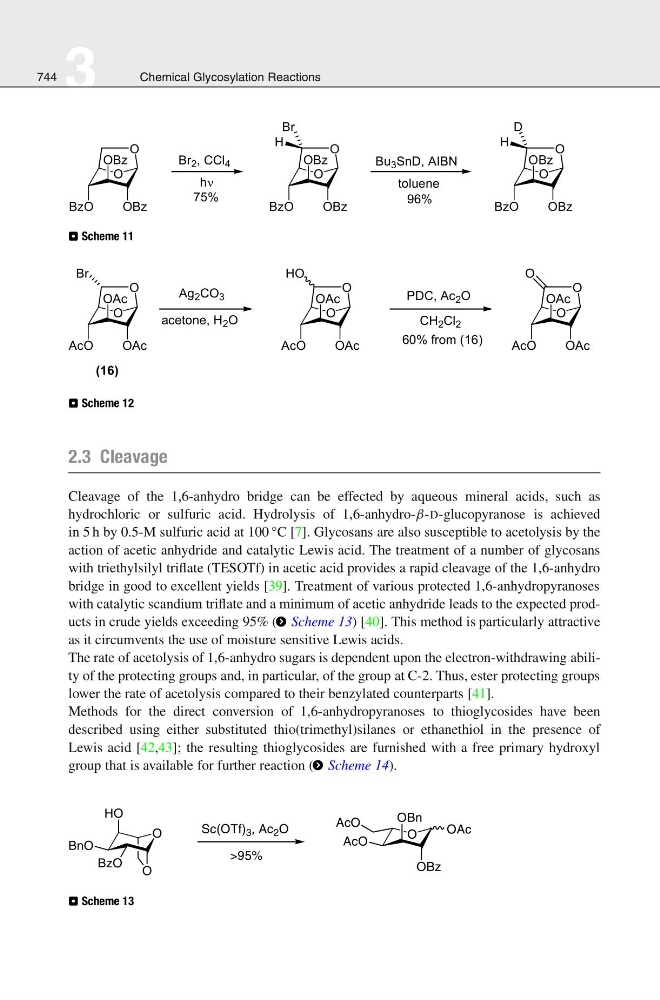
⊡ Scheme 11
⊡ Scheme 12
2.3 Cleavage
Cleavage of the 1,6-anhydro bridge can be effected by aqueous mineral acids, such as
hydrochloric or sulfuric acid. Hydrolysis of 1,6-anhydro-β-D-glucopyranose is achieved
in 5 h by 0.5-M sulfuric acid at 100 °C [7]. Glycosans are also susceptible to acetolysis by the
action of acetic anhydride and catalytic Lewis acid. The treatment of a number of glycosans
with triethylsilyl triflate (TESOTf) in acetic acid provides a rapid cleavage of the 1,6-anhydro
bridge in good to excellent yields [39]. Treatment of various protected 1,6-anhydropyranoses
with catalytic scandium triflate and a minimum of acetic anhydride leads to the expected products in crude yields exceeding 95% ( > Scheme 13) [40]. This method is particularly attractive
as it circumvents the use of moisture sensitive Lewis acids.
The rate of acetolysis of 1,6-anhydro sugars is dependent upon the electron-withdrawing ability of the protecting groups and, in particular, of the group at C-2. Thus, ester protecting groups
lower the rate of acetolysis compared to their benzylated counterparts [41].
Methods for the direct conversion of 1,6-anhydropyranoses to thioglycosides have been
described using either substituted thio(trimethyl)silanes or ethanethiol in the presence of
Lewis acid [42,43]; the resulting thioglycosides are furnished with a free primary hydroxyl
group that is available for further reaction ( > Scheme 14).
⊡ Scheme 13