

Anomeric Anhydro Sugars
3.7
743
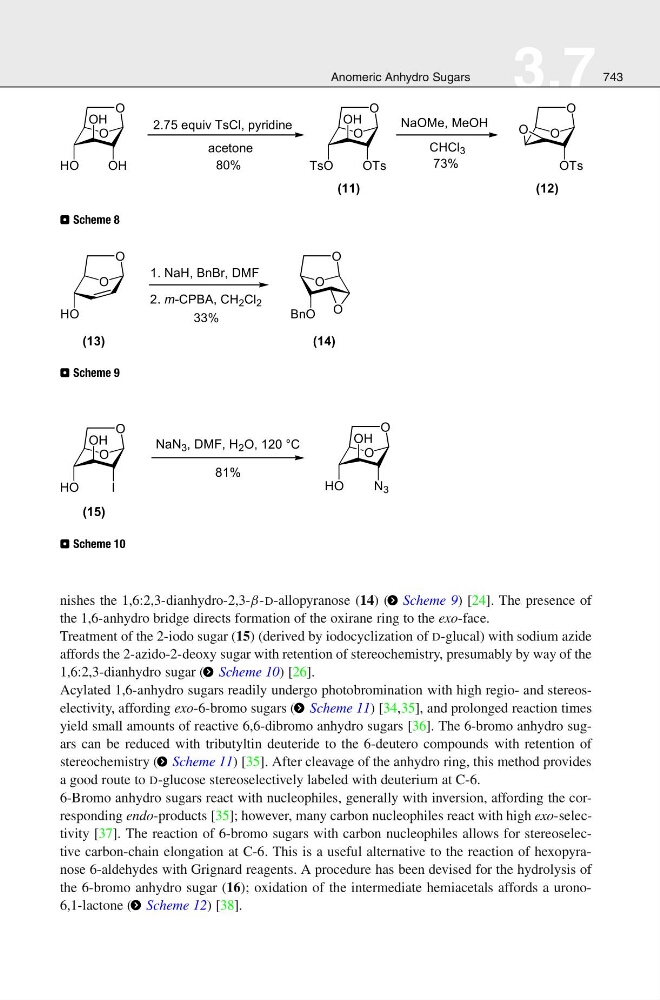
⊡ Scheme 8
⊡ Scheme 9
⊡ Scheme 10
nishes the 1,6:2,3-dianhydro-2,3-β-D-allopyranose (14) ( > Scheme 9) [24]. The presence of
the 1,6-anhydro bridge directs formation of the oxirane ring to the exo-face.
Treatment of the 2-iodo sugar (15) (derived by iodocyclization of D-glucal) with sodium azide
affords the 2-azido-2-deoxy sugar with retention of stereochemistry, presumably by way of the
1,6:2,3-dianhydro sugar ( > Scheme 10) [26].
Acylated 1,6-anhydro sugars readily undergo photobromination with high regio- and stereoselectivity, affording exo-6-bromo sugars ( > Scheme 11) [34,35], and prolonged reaction times
yield small amounts of reactive 6,6-dibromo anhydro sugars [36]. The 6-bromo anhydro sugars can be reduced with tributyltin deuteride to the 6-deutero compounds with retention of
stereochemistry ( > Scheme 11) [35]. After cleavage of the anhydro ring, this method provides
a good route to D-glucose stereoselectively labeled with deuterium at C-6.
6-Bromo anhydro sugars react with nucleophiles, generally with inversion, affording the corresponding endo-products [35]; however, many carbon nucleophiles react with high exo-selectivity [37]. The reaction of 6-bromo sugars with carbon nucleophiles allows for stereoselective carbon-chain elongation at C-6. This is a useful alternative to the reaction of hexopyranose 6-aldehydes with Grignard reagents. A procedure has been devised for the hydrolysis of
the 6-bromo anhydro sugar (16); oxidation of the intermediate hemiacetals affords a urono6,1-lactone ( > Scheme 12) [38].