

742
3
Chemical Glycosylation Reactions
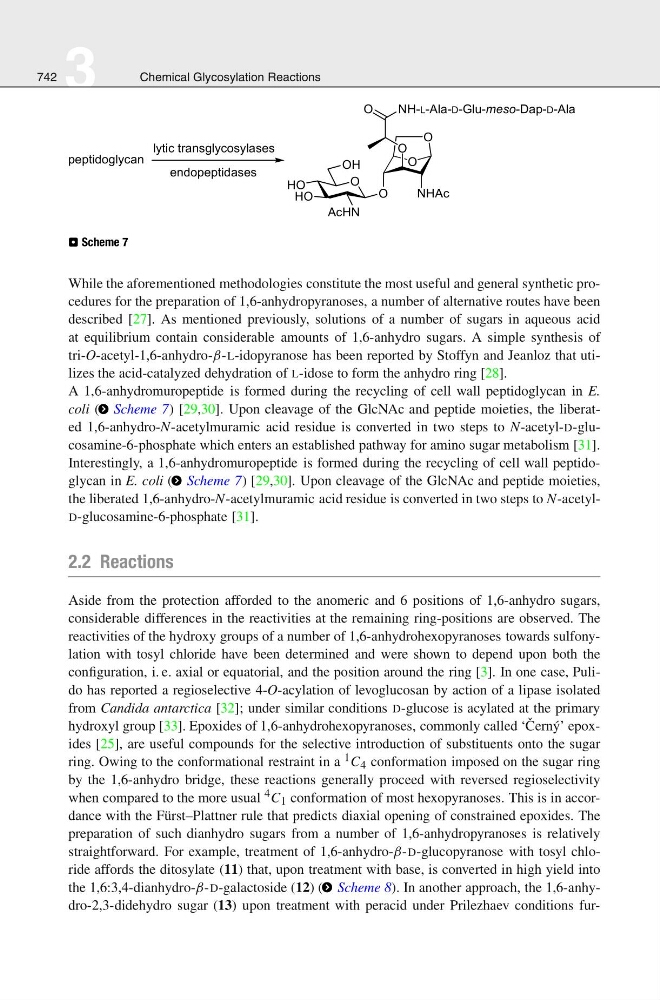
⊡ Scheme 7
While the aforementioned methodologies constitute the most useful and general synthetic procedures for the preparation of 1,6-anhydropyranoses, a number of alternative routes have been
described [27]. As mentioned previously, solutions of a number of sugars in aqueous acid
at equilibrium contain considerable amounts of 1,6-anhydro sugars. A simple synthesis of
tri-O-acetyl-1,6-anhydro-β-L-idopyranose has been reported by Stoffyn and Jeanloz that utilizes the acid-catalyzed dehydration of L-idose to form the anhydro ring [28].
A 1,6-anhydromuropeptide is formed during the recycling of cell wall peptidoglycan in E.
coli ( > Scheme 7) [29,30]. Upon cleavage of the GlcNAc and peptide moieties, the liberated 1,6-anhydro-N-acetylmuramic acid residue is converted in two steps to N-acetyl-D-glucosamine-6-phosphate which enters an established pathway for amino sugar metabolism [31].
Interestingly, a 1,6-anhydromuropeptide is formed during the recycling of cell wall peptidoglycan in E. coli ( > Scheme 7) [29,30]. Upon cleavage of the GlcNAc and peptide moieties,
the liberated 1,6-anhydro-N-acetylmuramic acid residue is converted in two steps to N-acetylD-glucosamine-6-phosphate [31].
2.2 Reactions
Aside from the protection afforded to the anomeric and 6 positions of 1,6-anhydro sugars,
considerable differences in the reactivities at the remaining ring-positions are observed. The
reactivities of the hydroxy groups of a number of 1,6-anhydrohexopyranoses towards sulfonylation with tosyl chloride have been determined and were shown to depend upon both the
configuration, i. e. axial or equatorial, and the position around the ring [3]. In one case, Pulido has reported a regioselective 4-O-acylation of levoglucosan by action of a lipase isolated
from Candida antarctica [32]; under similar conditions D-glucose is acylated at the primary
hydroxyl group [33]. Epoxides of 1,6-anhydrohexopyranoses, commonly called ‘ ˇ
Cerný’ epoxides [25], are useful compounds for the selective introduction of substituents onto the sugar
ring. Owing to the conformational restraint in a 1 C 4 conformation imposed on the sugar ring
by the 1,6-anhydro bridge, these reactions generally proceed with reversed regioselectivity
when compared to the more usual 4 C 1 conformation of most hexopyranoses. This is in accordance with the Fürst–Plattner rule that predicts diaxial opening of constrained epoxides. The
preparation of such dianhydro sugars from a number of 1,6-anhydropyranoses is relatively
straightforward. For example, treatment of 1,6-anhydro-β-D-glucopyranose with tosyl chloride affords the ditosylate (11) that, upon treatment with base, is converted in high yield into
the 1,6:3,4-dianhydro-β-D-galactoside (12) ( > Scheme 8). In another approach, the 1,6-anhydro-2,3-didehydro sugar (13) upon treatment with peracid under Prilezhaev conditions fur-