

Glycal Derivatives
3.6
709
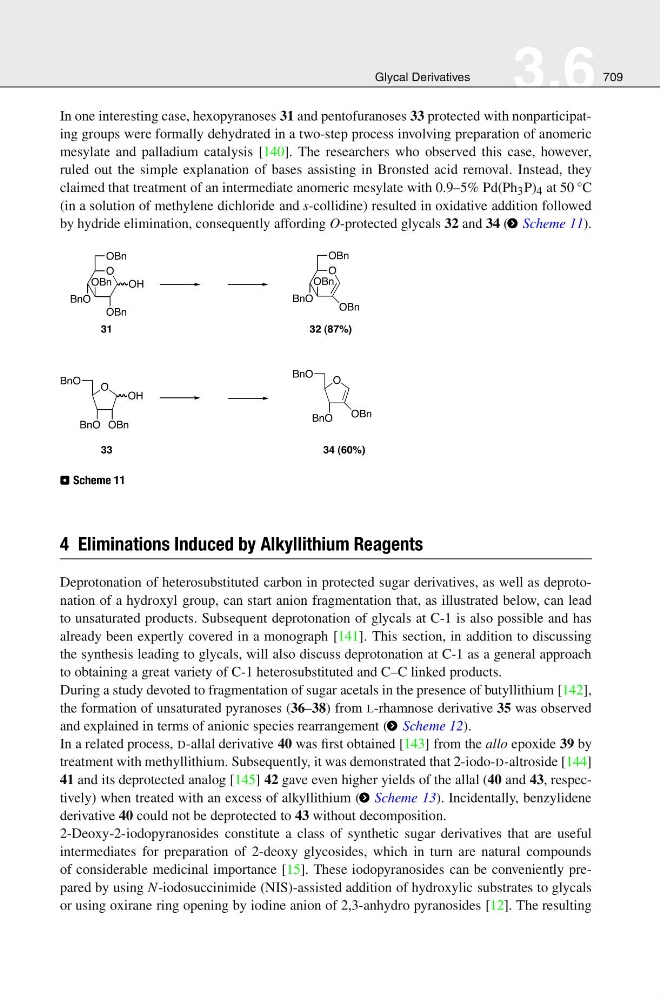
In one interesting case, hexopyranoses 31 and pentofuranoses 33 protected with nonparticipating groups were formally dehydrated in a two-step process involving preparation of anomeric
mesylate and palladium catalysis [140]. The researchers who observed this case, however,
ruled out the simple explanation of bases assisting in Bronsted acid removal. Instead, they
claimed that treatment of an intermediate anomeric mesylate with 0.9–5% Pd(Ph 3 P) 4 at 50 °C
(in a solution of methylene dichloride and s-collidine) resulted in oxidative addition followed
by hydride elimination, consequently affording O-protected glycals 32 and 34 ( > Scheme 11).
⊡ Scheme 11
4 Eliminations Induced by Alkyllithium Reagents
Deprotonation of heterosubstituted carbon in protected sugar derivatives, as well as deprotonation of a hydroxyl group, can start anion fragmentation that, as illustrated below, can lead
to unsaturated products. Subsequent deprotonation of glycals at C-1 is also possible and has
already been expertly covered in a monograph [141]. This section, in addition to discussing
the synthesis leading to glycals, will also discuss deprotonation at C-1 as a general approach
to obtaining a great variety of C-1 heterosubstituted and C–C linked products.
During a study devoted to fragmentation of sugar acetals in the presence of butyllithium [142],
the formation of unsaturated pyranoses (36–38) from L-rhamnose derivative 35 was observed
and explained in terms of anionic species rearrangement ( > Scheme 12).
In a related process, D-allal derivative 40 was first obtained [143] from the allo epoxide 39 by
treatment with methyllithium. Subsequently, it was demonstrated that 2-iodo-D-altroside [144]
41 and its deprotected analog [145] 42 gave even higher yields of the allal (40 and 43, respectively) when treated with an excess of alkyllithium ( > Scheme 13). Incidentally, benzylidene
derivative 40 could not be deprotected to 43 without decomposition.
2-Deoxy-2-iodopyranosides constitute a class of synthetic sugar derivatives that are useful
intermediates for preparation of 2-deoxy glycosides, which in turn are natural compounds
of considerable medicinal importance [15]. These iodopyranosides can be conveniently prepared by using N-iodosuccinimide (NIS)-assisted addition of hydroxylic substrates to glycals
or using oxirane ring opening by iodine anion of 2,3-anhydro pyranosides [12]. The resulting