

708
3
Chemical Glycosylation Reactions
oylated [126] glycosyl bromides. In the case of 2-O-acetyl-3,4,6-tri-O-benzyl-D-glucopyranosyl bromide, DBU was applied, together with sodium iodide, in acetone [117].
Obviously, the tendency to eliminate HBr from glycosyl bromides, or other protic acids from
a sugar derivative bearing a good leaving group at an anomeric position, can be considerably
enhanced by exploiting the possibility of forming a conjugated double bond system. Such
an arrangement of functional groups exists in natural products (for example, in members of
the neuraminic acid family [127,128,129], and it is well known that corresponding sialic acid
glycals [130,131,132,133] can be prepared by treating peracetylated derivatives with substoichiometric amounts of trimethylsilyl triflate.
On the other hand, an electron-withdrawing functional group can be introduced in position C-3
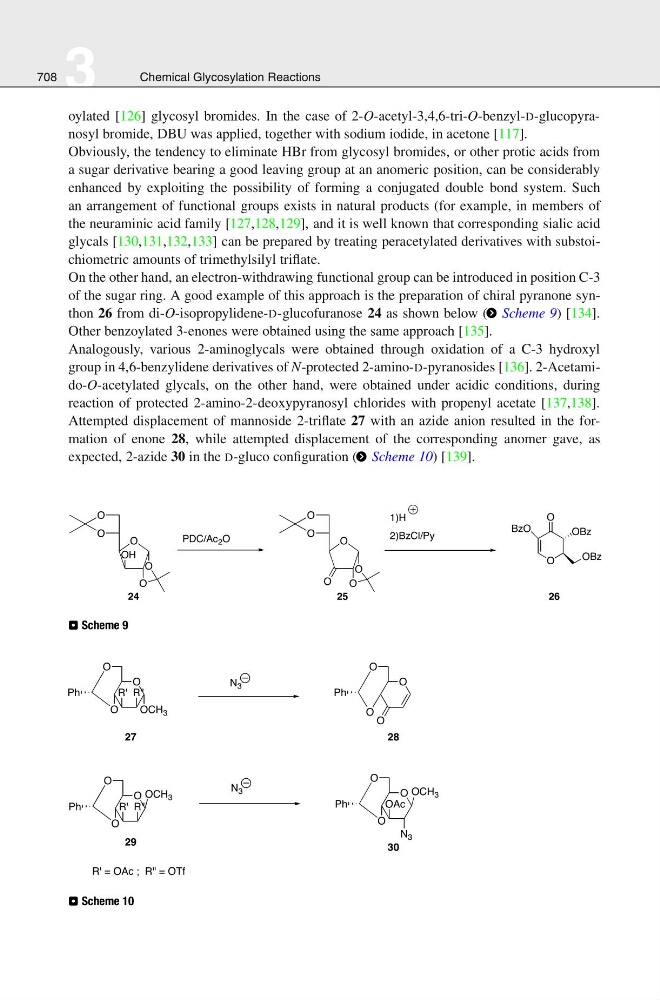
of the sugar ring. A good example of this approach is the preparation of chiral pyranone synthon 26 from di-O-isopropylidene-D-glucofuranose 24 as shown below ( > Scheme 9) [134].
Other benzoylated 3-enones were obtained using the same approach [135].
Analogously, various 2-aminoglycals were obtained through oxidation of a C-3 hydroxyl
group in 4,6-benzylidene derivatives of N-protected 2-amino-D-pyranosides [136]. 2-Acetamido-O-acetylated glycals, on the other hand, were obtained under acidic conditions, during
reaction of protected 2-amino-2-deoxypyranosyl chlorides with propenyl acetate [137,138].
Attempted displacement of mannoside 2-triflate 27 with an azide anion resulted in the formation of enone 28, while attempted displacement of the corresponding anomer gave, as
expected, 2-azide 30 in the D-gluco configuration ( > Scheme 10) [139].
⊡ Scheme 9
⊡ Scheme 10