

Glycal Derivatives
3.6
707
orthoesters [107]. In the case of ethanethiol, glycosylation in the presence of triethylamine in
acetonitrile resulted in elimination [108].
Other studies led to the successful yet sometimes unintentional isolation of glycals. For
instance, heating acetylated glucopyranosyl bromide in nitromethane with nicotinamide gave
peracetyl-2-hydroxy-D-glucal 21 along with both anomers of quaternary N-glycosides [109].
Studies of reactions of peracetylated -D-hexopyranosyl bromides with sodium 4-nitrophenoxide in dimethylformamide [110] revealed a strong correlation between sugar configuration and
elimination product. Depending on the sugar, the yields of 2-acetoxyglycals diminished from
61 to 8% (allo > gulo > gluco > galacto), while the effectiveness of substitution with phenoxide anion followed the reverse order. A dispute over the scope of phase-transfer glycosylating
reactions employing acylated glycosyl bromides and protic acid substrates led to the finding
that application of 2,3,4,6-tetra-O-acetyl-D-glucopyranosyl bromide [111] or benzoylated
glycosyl bromide [112] can give acylated glycals as common side products. For example, in
phase-transfer reactions with a series of 44 phenolic substrates, acetylated α-D-galactopyranosyl bromide afforded the expected aryl β-galactopyranosides in yields ranging from 29 to
87% but no elimination product [113]; in contrast, during attempted glycosylation of a sugar substrate in the presence of silver trifluoromethanesulfonate and 2,4,6-trimethylpyridine,
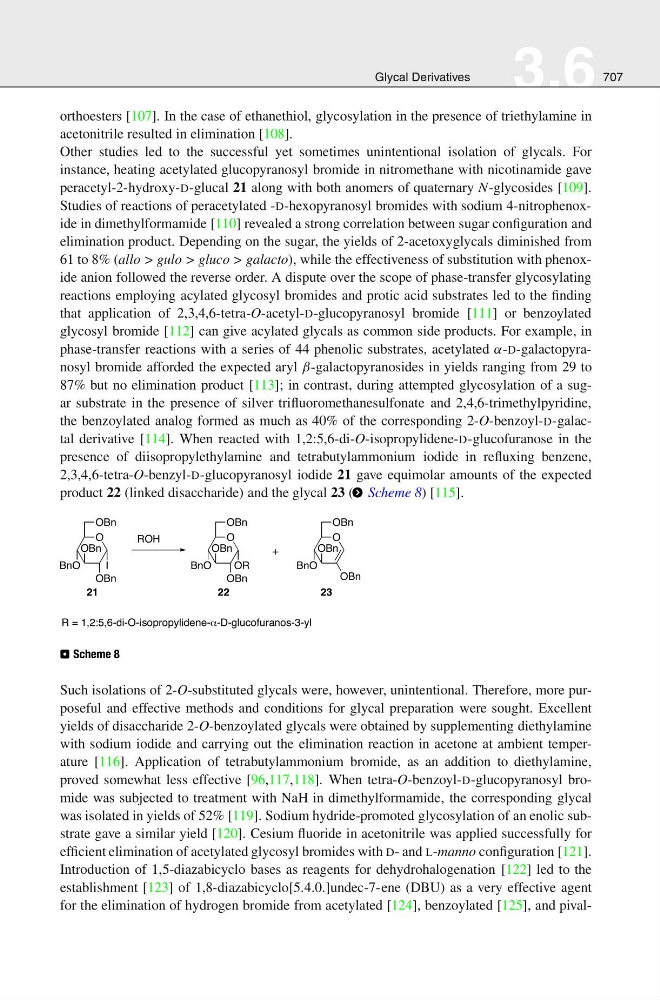
the benzoylated analog formed as much as 40% of the corresponding 2-O-benzoyl-D-galactal derivative [114]. When reacted with 1,2:5,6-di-O-isopropylidene-D-glucofuranose in the
presence of diisopropylethylamine and tetrabutylammonium iodide in refluxing benzene,
2,3,4,6-tetra-O-benzyl-D-glucopyranosyl iodide 21 gave equimolar amounts of the expected
product 22 (linked disaccharide) and the glycal 23 ( > Scheme 8) [115].
⊡ Scheme 8
Such isolations of 2-O-substituted glycals were, however, unintentional. Therefore, more purposeful and effective methods and conditions for glycal preparation were sought. Excellent
yields of disaccharide 2-O-benzoylated glycals were obtained by supplementing diethylamine
with sodium iodide and carrying out the elimination reaction in acetone at ambient temperature [116]. Application of tetrabutylammonium bromide, as an addition to diethylamine,
proved somewhat less effective [96,117,118]. When tetra-O-benzoyl-D-glucopyranosyl bromide was subjected to treatment with NaH in dimethylformamide, the corresponding glycal
was isolated in yields of 52% [119]. Sodium hydride-promoted glycosylation of an enolic substrate gave a similar yield [120]. Cesium fluoride in acetonitrile was applied successfully for
efficient elimination of acetylated glycosyl bromides with D- and L-manno configuration [121].
Introduction of 1,5-diazabicyclo bases as reagents for dehydrohalogenation [122] led to the
establishment [123] of 1,8-diazabicyclo[5.4.0.]undec-7-ene (DBU) as a very effective agent
for the elimination of hydrogen bromide from acetylated [124], benzoylated [125], and pival-