

706
3
Chemical Glycosylation Reactions
of isolated glycals are high. Corresponding phenyl sulfones follow the same reaction pathway [87]. Anomeric sulfoxides form glycals upon treatment with 3 equivalents of butyllithium
in THF at −78 °C. The yield of products generated from pyranosyl derivatives protected with
acetal and ether groups ranges from 51 to 86% [88].
Although there is much new evidence testifying to the potential complexity of glycosyl
halide reductive transformations, this evidence has not significantly influenced laboratory
practices for the preparation of glycals from simple sugars. One paper [89] outlined a general
method amenable to large-scale synthesis; the method involved a one-pot, three-step procedure
involving peracetylation of an aldose, synthesis of a glycosyl bromide, and bromide reductive
elimination. For D-glucose, the last step uses a Zn/AcOH/AcONa/CuSO 4 mixture that yields
98% 3,4,6-tri-O-acetyl-D-glucal. Another improved version of glycal synthesis, devised by
Franck [90], uses vitamin B-12 as a catalyst for reductive eliminations [91]. With methanol
as solvent, acetylated glycals were conveniently prepared by this method in the presence of
metallic zinc and ammonium chloride in yields exceeding 90%. In the case of an L-rhamnal
derivative, however, column chromatography had to be applied to isolate product in a 45%
yield. Both the original and modified procedures of glycal preparation are reasonably tolerant
of the inclusion of commonly applied functionalities, including glycosidic bonds. In fact,
a number of glycals have already been prepared by different procedures from peracetylated
disaccharides and trisaccharides [92,93,94,95,96,97,98,99,100].
3 Base-Catalyzed Eliminations of Glycosyl Halides
to Yield 2-Oxy-hex-1-enitols
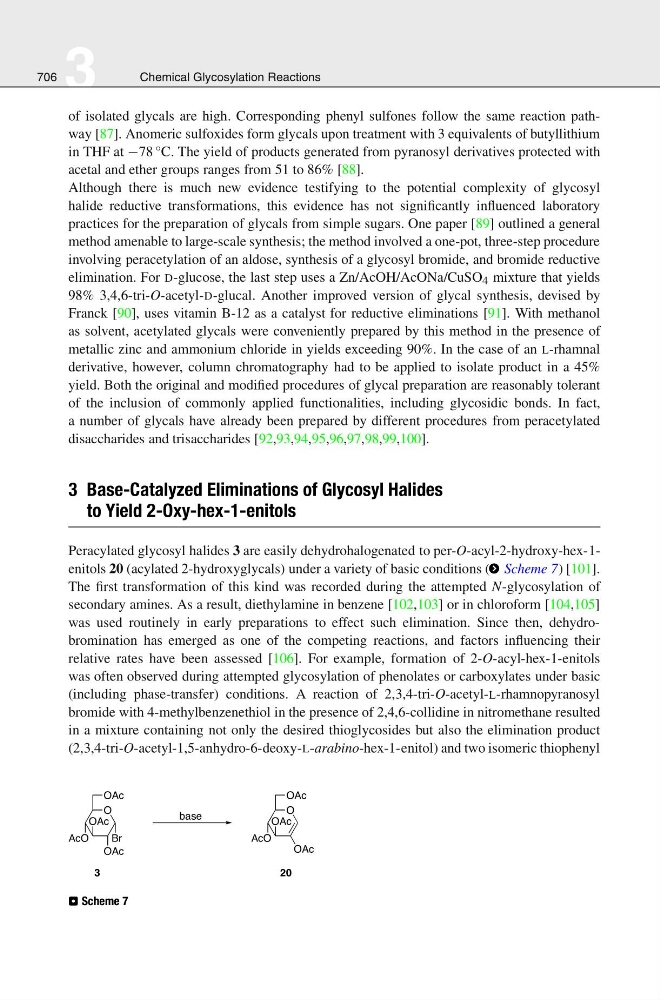
Peracylated glycosyl halides 3 are easily dehydrohalogenated to per-O-acyl-2-hydroxy-hex-1enitols 20 (acylated 2-hydroxyglycals) under a variety of basic conditions ( > Scheme 7) [101].
The first transformation of this kind was recorded during the attempted N-glycosylation of
secondary amines. As a result, diethylamine in benzene [102,103] or in chloroform [104,105]
was used routinely in early preparations to effect such elimination. Since then, dehydrobromination has emerged as one of the competing reactions, and factors influencing their
relative rates have been assessed [106]. For example, formation of 2-O-acyl-hex-1-enitols
was often observed during attempted glycosylation of phenolates or carboxylates under basic
(including phase-transfer) conditions. A reaction of 2,3,4-tri-O-acetyl-L-rhamnopyranosyl
bromide with 4-methylbenzenethiol in the presence of 2,4,6-collidine in nitromethane resulted
in a mixture containing not only the desired thioglycosides but also the elimination product
(2,3,4-tri-O-acetyl-1,5-anhydro-6-deoxy-L-arabino-hex-1-enitol) and two isomeric thiophenyl
⊡ Scheme 7