

Glycal Derivatives
3.6
705
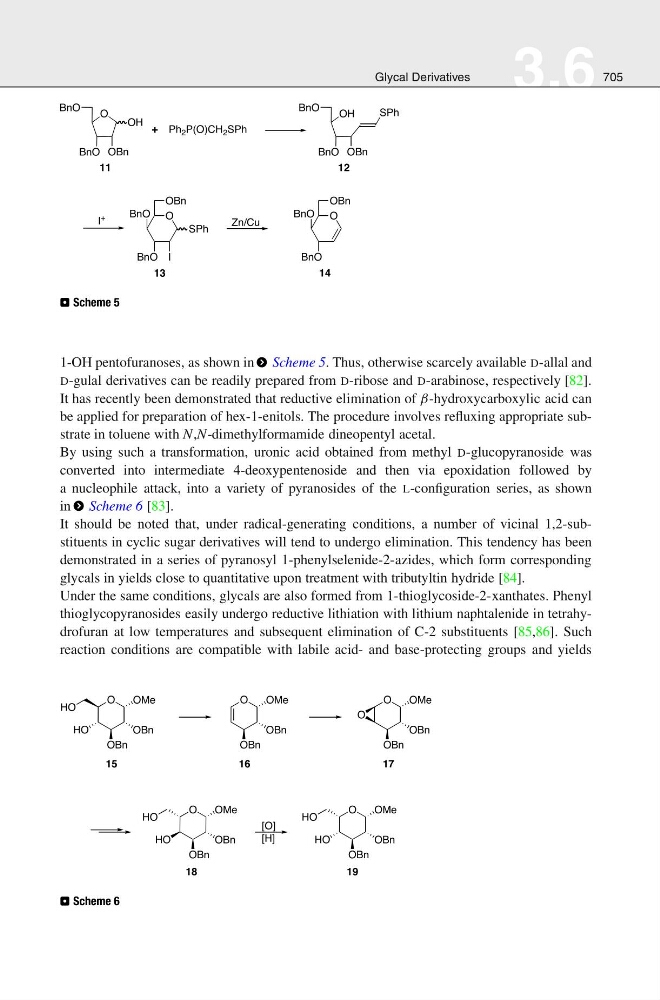
⊡ Scheme 5
1-OH pentofuranoses, as shown in > Scheme 5. Thus, otherwise scarcely available D-allal and
D-gulal derivatives can be readily prepared from D-ribose and D-arabinose, respectively [82].
It has recently been demonstrated that reductive elimination of β-hydroxycarboxylic acid can
be applied for preparation of hex-1-enitols. The procedure involves refluxing appropriate substrate in toluene with N,N-dimethylformamide dineopentyl acetal.
By using such a transformation, uronic acid obtained from methyl D-glucopyranoside was
converted into intermediate 4-deoxypentenoside and then via epoxidation followed by
a nucleophile attack, into a variety of pyranosides of the L-configuration series, as shown
in > Scheme 6 [83].
It should be noted that, under radical-generating conditions, a number of vicinal 1,2-substituents in cyclic sugar derivatives will tend to undergo elimination. This tendency has been
demonstrated in a series of pyranosyl 1-phenylselenide-2-azides, which form corresponding
glycals in yields close to quantitative upon treatment with tributyltin hydride [84].
Under the same conditions, glycals are also formed from 1-thioglycoside-2-xanthates. Phenyl
thioglycopyranosides easily undergo reductive lithiation with lithium naphtalenide in tetrahydrofuran at low temperatures and subsequent elimination of C-2 substituents [85,86]. Such
reaction conditions are compatible with labile acid- and base-protecting groups and yields
⊡ Scheme 6