

704
3
Chemical Glycosylation Reactions
corresponding glycals. The beneficial influence of triethylamine and pyridine addition on zincmediated reductive elimination was first noticed in the case of acylated 1-bromo-D-glycosyl
cyanides [77] and was further noticed in other monosaccharide derivatives substituted with an
electron-withdrawing group and bromine atom at the anomeric center [78,79]. To identify the
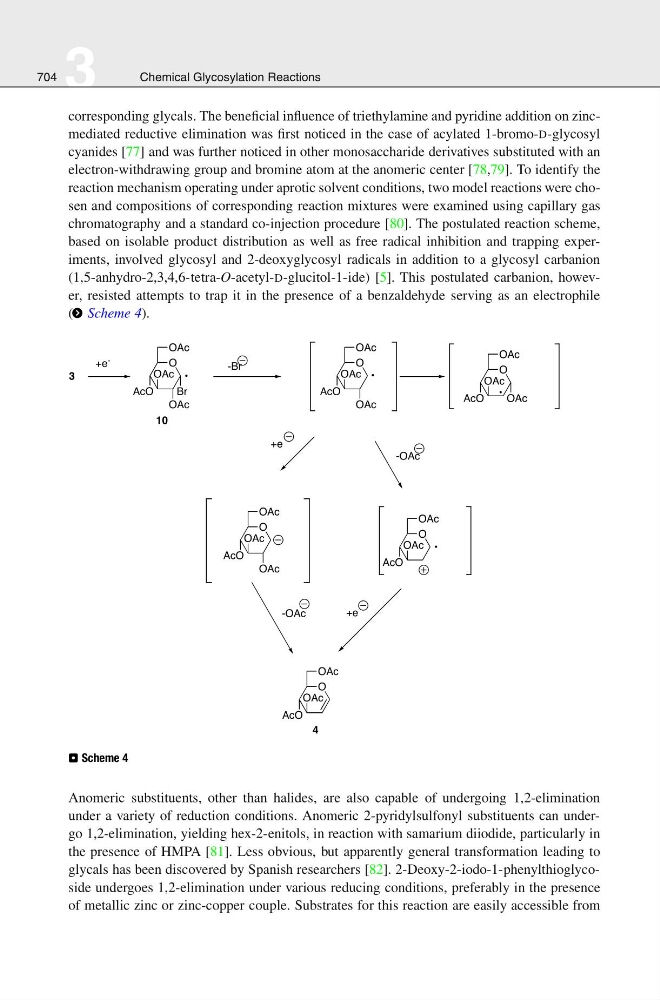
reaction mechanism operating under aprotic solvent conditions, two model reactions were chosen and compositions of corresponding reaction mixtures were examined using capillary gas
chromatography and a standard co-injection procedure [80]. The postulated reaction scheme,
based on isolable product distribution as well as free radical inhibition and trapping experiments, involved glycosyl and 2-deoxyglycosyl radicals in addition to a glycosyl carbanion
(1,5-anhydro-2,3,4,6-tetra-O-acetyl-D-glucitol-1-ide) [5]. This postulated carbanion, however, resisted attempts to trap it in the presence of a benzaldehyde serving as an electrophile
( > Scheme 4).
⊡ Scheme 4
Anomeric substituents, other than halides, are also capable of undergoing 1,2-elimination
under a variety of reduction conditions. Anomeric 2-pyridylsulfonyl substituents can undergo 1,2-elimination, yielding hex-2-enitols, in reaction with samarium diiodide, particularly in
the presence of HMPA [81]. Less obvious, but apparently general transformation leading to
glycals has been discovered by Spanish researchers [82]. 2-Deoxy-2-iodo-1-phenylthioglycoside undergoes 1,2-elimination under various reducing conditions, preferably in the presence
of metallic zinc or zinc-copper couple. Substrates for this reaction are easily accessible from