

Glycal Derivatives
3.6
703
cedure [60,61]. Meanwhile, Ireland’s innovative application of lithium in liquid ammonia as
a reducing agent for furanosyl halides [62,63] became a widespread procedure [64]. However,
it has been demonstrated that, in special cases (i. e., when there are benzyl protective groups
present and there is no heteroatom substitution at C-3), even furanoid glycals can be prepared
by the zinc/acetic acid method [65].
Considerable attention has been given to reactive metal–graphite combinations, which were
found to reduce both O-acylated pyranosyl and O-alkylidene furanosyl halide substrates under
neutral conditions and to give excellent yields of high-purity glycals. Zinc/silver-graphite in
tetrahydrofuran [66,67] and potassium graphite laminate [68] in the same solvent are very
reactive, which allows the reaction work-up to be reduced to simple filtration and evaporation.
The potassium graphite reagent is unique in effectively eliminating the 2-benzyloxy substituent
from per-O-benzylated glycosyl halides, thus affording direct access to 3,4,6-tri-O-benzylD-glucal [69,70] and circumventing, in this case, the need for benzylation of preformed glucal
derivatives.
Two other interesting reagents are samarium iodide and dimeric cyclopentadiene-titanium
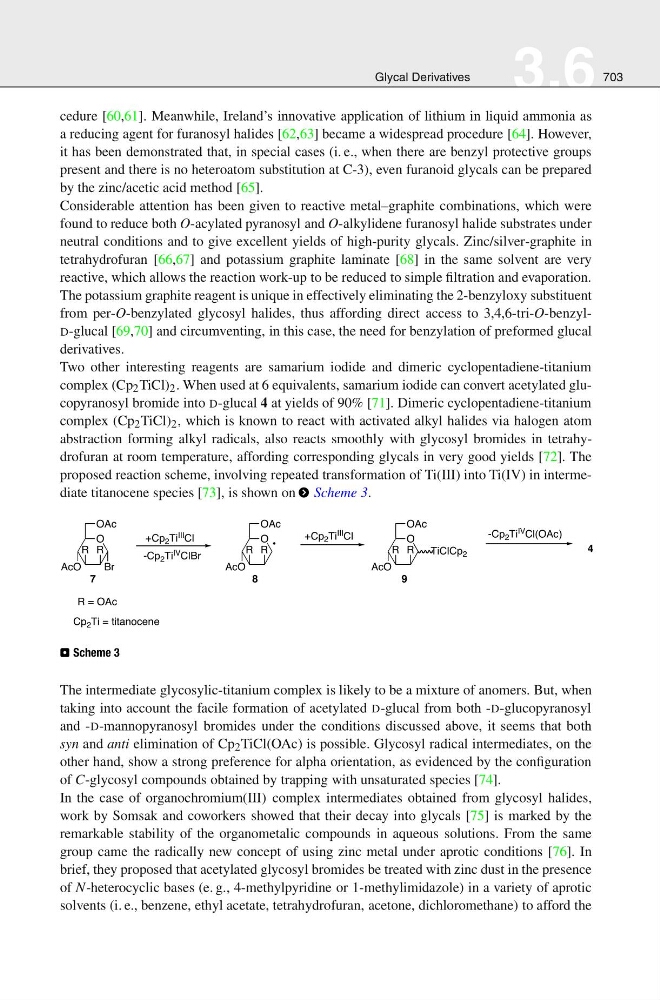
complex (Cp 2 TiCl) 2 . When used at 6 equivalents, samarium iodide can convert acetylated glucopyranosyl bromide into D-glucal 4 at yields of 90% [71]. Dimeric cyclopentadiene-titanium
complex (Cp 2 TiCl) 2 , which is known to react with activated alkyl halides via halogen atom
abstraction forming alkyl radicals, also reacts smoothly with glycosyl bromides in tetrahydrofuran at room temperature, affording corresponding glycals in very good yields [72]. The
proposed reaction scheme, involving repeated transformation of Ti(III) into Ti(IV) in intermediate titanocene species [73], is shown on > Scheme 3.
⊡ Scheme 3
The intermediate glycosylic-titanium complex is likely to be a mixture of anomers. But, when
taking into account the facile formation of acetylated D-glucal from both -D-glucopyranosyl
and -D-mannopyranosyl bromides under the conditions discussed above, it seems that both
syn and anti elimination of Cp 2 TiCl(OAc) is possible. Glycosyl radical intermediates, on the
other hand, show a strong preference for alpha orientation, as evidenced by the configuration
of C-glycosyl compounds obtained by trapping with unsaturated species [74].
In the case of organochromium(III) complex intermediates obtained from glycosyl halides,
work by Somsak and coworkers showed that their decay into glycals [75] is marked by the
remarkable stability of the organometalic compounds in aqueous solutions. From the same
group came the radically new concept of using zinc metal under aprotic conditions [76]. In
brief, they proposed that acetylated glycosyl bromides be treated with zinc dust in the presence
of N-heterocyclic bases (e. g., 4-methylpyridine or 1-methylimidazole) in a variety of aprotic
solvents (i. e., benzene, ethyl acetate, tetrahydrofuran, acetone, dichloromethane) to afford the