

702
3
Chemical Glycosylation Reactions
Another approach (and one more important for assessing the mechanisms of glycal formation
than for practical use) involved the electro-reduction of 2,3,4,6-tetra-O-acetyl-D-glucopyranosyl bromide 3 on mercury electrode in dipolar aprotic solvents containing tetraethylammonium perchlorate to support a mechanistic two-electron reduction hypothesis [52]. However,
3,4,6-tri-O-acetyl-D-glucal 4 was obtained in only 55% yield. The main product 4 was accompanied by penta-O-acetyl-D-glucopyranose (35%) and 2-acetoxy-3,4,6-tri-O-acetyl-D-glucal
(10%), indicating the extent of secondary solvolytic processes in this method.
The composition of reaction mixtures obtained under classical Fischer–Zach conditions was
determined by capillary gas chromatography [53] of per-O-silylated and per-O-acetylated
components of the crude reaction mixtures, and some progress was made in explaining the
mechanism behind typical side-product formation. The compounds identified included products of solvolytic displacement of an anomeric bromine by acetic acid and water as well as
2,3-unsaturated derivatives. Interestingly, there was a difference in the reaction outcome of
pentopyranosyl versus hexopyranosyl substrates. In the former case, glycals were accompanied by acetylated 1,5-anhydropentitols; in the latter, hex-1-enitols contained admixtures of
peracetylated 2-deoxyhexopyranosides.
One failed attempt to convert peracetylated glycosyl chlorides into the corresponding glycals
used zinc dust in aqueous acetic acid [54]. However, when an excess of chromium(II) diacetate dimer monohydrate was used together with 1,2-ethanediamine in dimethylformamide to
generate α-pyranosyl chlorides of D-glucose, D-xylose, and D-arabinose, the corresponding
glycals were obtained in yields of 82–97%.
Aluminum amalgam has been shown to be an effective reducing-eliminating reagent for glycosyl bromides when used in aqueous tetrahydrofuran [55], producing 60–85% yields of product.
From the design of alternative procedures employing aprotic reaction conditions have come
synthetic methodologies for the preparation of glycals from pyranose derivatives bearing acidsensitive protecting groups and even from furanose derivatives. The first attempts in this direction, consisting of treating pentofuranosyl bromides bearing good leaving groups at C-2 with
sodium iodide in dry acetone [56], generated a hitherto unknown class of furanosyl glycals.
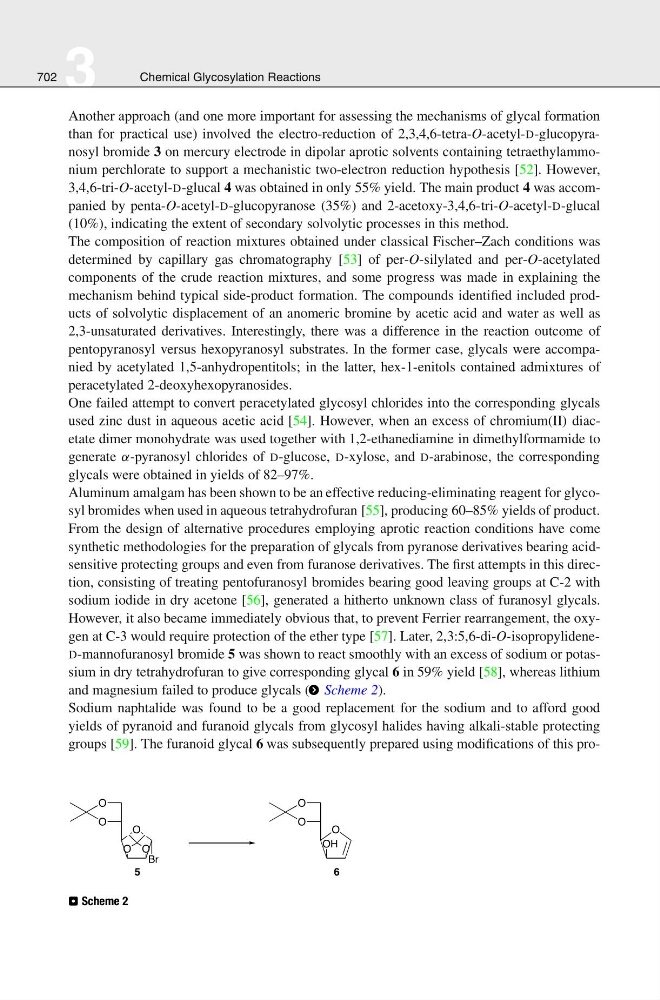
However, it also became immediately obvious that, to prevent Ferrier rearrangement, the oxygen at C-3 would require protection of the ether type [57]. Later, 2,3:5,6-di-O-isopropylideneD-mannofuranosyl bromide 5 was shown to react smoothly with an excess of sodium or potassium in dry tetrahydrofuran to give corresponding glycal 6 in 59% yield [58], whereas lithium
and magnesium failed to produce glycals ( > Scheme 2).
Sodium naphtalide was found to be a good replacement for the sodium and to afford good
yields of pyranoid and furanoid glycals from glycosyl halides having alkali-stable protecting
groups [59]. The furanoid glycal 6 was subsequently prepared using modifications of this pro⊡ Scheme 2