

Glycal Derivatives
3.6
701
2 Reductive Elimination of Glycosyl Halides
Because of their facile preparation and reactivity, glycosyl halides are commonly used in carbohydrate chemistry. They are primarily used as glycosyl donors [35,36] and are the most
important substrates in the synthesis of glycals from monosaccharides. Especially useful are
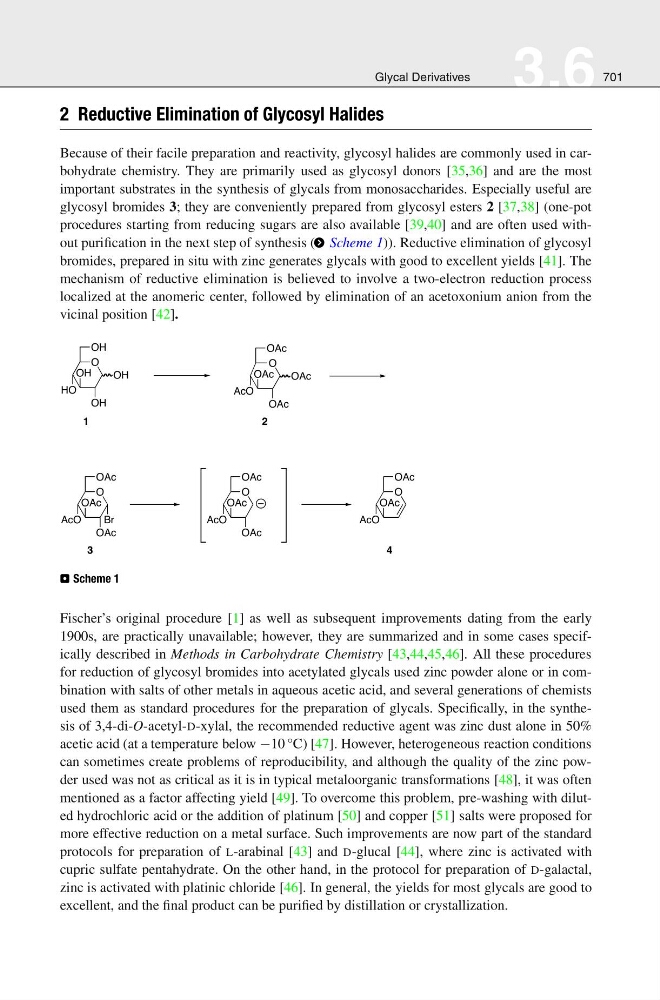
glycosyl bromides 3; they are conveniently prepared from glycosyl esters 2 [37,38] (one-pot
procedures starting from reducing sugars are also available [39,40] and are often used without purification in the next step of synthesis ( > Scheme 1)). Reductive elimination of glycosyl
bromides, prepared in situ with zinc generates glycals with good to excellent yields [41]. The
mechanism of reductive elimination is believed to involve a two-electron reduction process
localized at the anomeric center, followed by elimination of an acetoxonium anion from the
vicinal position [42].
⊡ Scheme 1
Fischer’s original procedure [1] as well as subsequent improvements dating from the early
1900s, are practically unavailable; however, they are summarized and in some cases specifically described in Methods in Carbohydrate Chemistry [43,44,45,46]. All these procedures
for reduction of glycosyl bromides into acetylated glycals used zinc powder alone or in combination with salts of other metals in aqueous acetic acid, and several generations of chemists
used them as standard procedures for the preparation of glycals. Specifically, in the synthesis of 3,4-di-O-acetyl-D-xylal, the recommended reductive agent was zinc dust alone in 50%
acetic acid (at a temperature below −10 °C) [47]. However, heterogeneous reaction conditions
can sometimes create problems of reproducibility, and although the quality of the zinc powder used was not as critical as it is in typical metaloorganic transformations [48], it was often
mentioned as a factor affecting yield [49]. To overcome this problem, pre-washing with diluted hydrochloric acid or the addition of platinum [50] and copper [51] salts were proposed for
more effective reduction on a metal surface. Such improvements are now part of the standard
protocols for preparation of L-arabinal [43] and D-glucal [44], where zinc is activated with
cupric sulfate pentahydrate. On the other hand, in the protocol for preparation of D-galactal,
zinc is activated with platinic chloride [46]. In general, the yields for most glycals are good to
excellent, and the final product can be purified by distillation or crystallization.