

710
3
Chemical Glycosylation Reactions
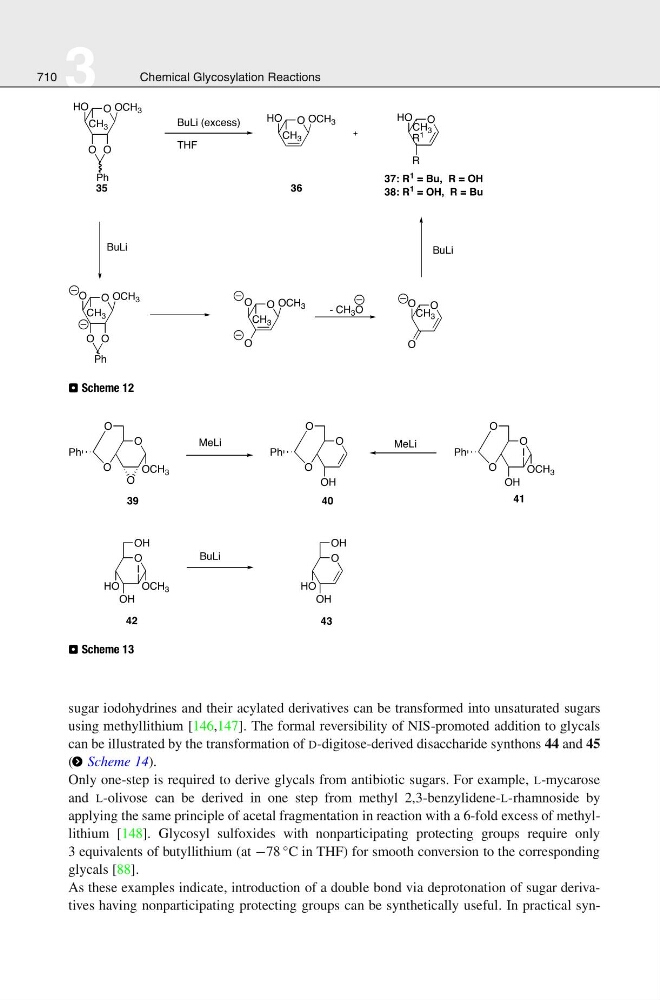
⊡ Scheme 12
⊡ Scheme 13
sugar iodohydrines and their acylated derivatives can be transformed into unsaturated sugars
using methyllithium [146,147]. The formal reversibility of NIS-promoted addition to glycals
can be illustrated by the transformation of D-digitose-derived disaccharide synthons 44 and 45
( > Scheme 14).
Only one-step is required to derive glycals from antibiotic sugars. For example, L-mycarose
and L-olivose can be derived in one step from methyl 2,3-benzylidene-L-rhamnoside by
applying the same principle of acetal fragmentation in reaction with a 6-fold excess of methyllithium [148]. Glycosyl sulfoxides with nonparticipating protecting groups require only
3 equivalents of butyllithium (at −78 °C in THF) for smooth conversion to the corresponding
glycals [88].
As these examples indicate, introduction of a double bond via deprotonation of sugar derivatives having nonparticipating protecting groups can be synthetically useful. In practical syn-