

692
3
Chemical Glycosylation Reactions
residue (the general acid/base) was mutated, a new type of mutant glycosidases was created,
named thioglycoligases by the developers, which were able to catalyze the reaction between
a glycosyl donor and a thiol acceptor to efficiently give thioglycosidically linked oligosaccharides ( > Scheme 63) [188]. Further studies showed that also the “double mutant” (called
thioglycosynthases), where both the carboxylates were removed could catalyze this type of
reaction [189]. So far only β-(1→4)-linkages have been produced using glucose and xylose
acceptors and glucose and mannose donors ( > Scheme 64) [190,191,192,193].
Interestingly, glycosyl transferases seem to tolerate thiol acceptors. Thus, using an α1,3-Galtransferase and an octyl 3 -thio-lactoside acceptor a thio-interglycosidic linkage was formed in
a very high yield. Surprisingly, the product was not the expected trisaccharide, but a tetrasaccharide with an extra (1→3)-O-linked galactose residue added. Here, the thiolinkages stability towards glycosidases could be utilized to selectively cleave the Gal-(1→3)-Gal O-glycosidic bond to obtain the desired trisaccharide product ( > Scheme 65). In addition, MS-data
were reported to show that the 3 -thiolactoside was also accepted by a β1,3GlcNac-transferase [194].
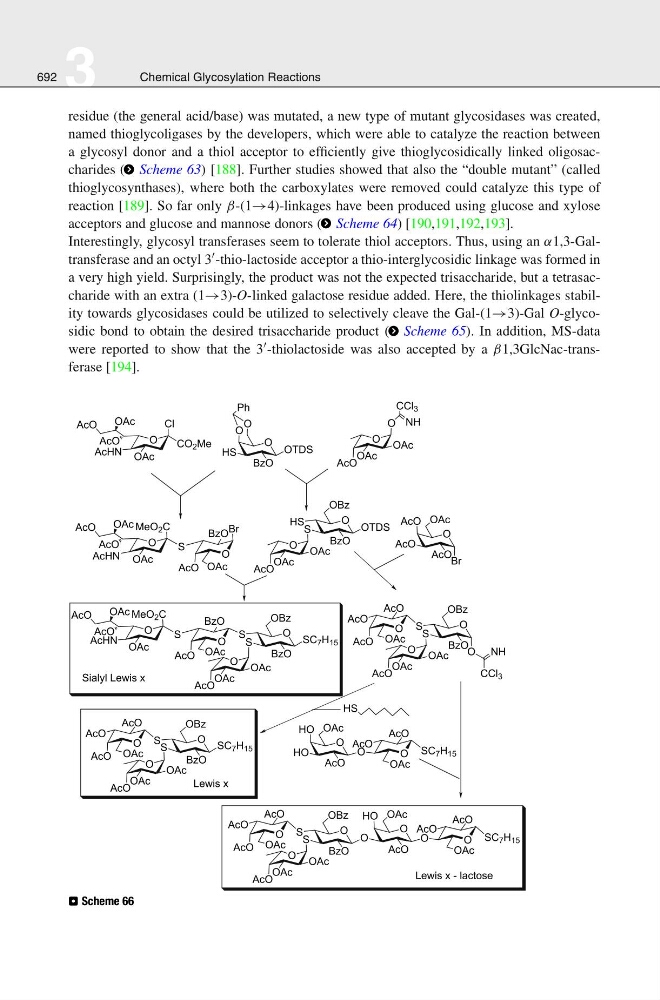
⊡ Scheme 66