

S-Glycosylation
3.5
691
3.2.3 Solid-Phase Synthesis of Thiooligosaccharides
Solid-phase syntheses of thiooligosaccharides in excellent yields have been described [186].
Unprotected monosaccharides with an anomeric ethyl disulfide group were attached to a solid
phase via their primary hydroxy group. Activation through the formation of the sodium thiolate
and subsequent reaction with a saccharide triflate gave thiodisaccharides, which can be cleaved
from the resin by treatment with TFA. If the electrophile contains an anomeric ethyl disulfide
group, the reaction sequence can be repeated to give thiooligosaccharides ( > Scheme 61).
3.2.4 Synthesis of Non-Reducing Sugars
The syntheses of thio analogues of non-reducing disaccharides could be categorized under
any of the above two headings since they involve both an anomeric thiol and an anomeric
electrophile. Both halo sugars and hemiacetals have been used as electrophiles ( > Scheme 62)
[70,187].
3.2.5 Enzymatic Synthesis
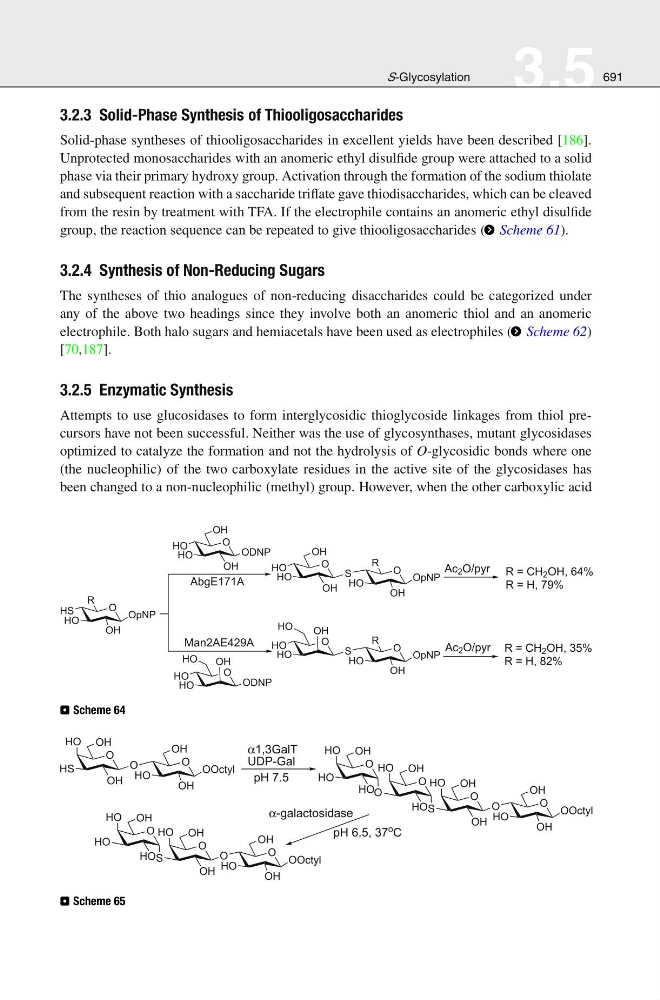
Attempts to use glucosidases to form interglycosidic thioglycoside linkages from thiol precursors have not been successful. Neither was the use of glycosynthases, mutant glycosidases
optimized to catalyze the formation and not the hydrolysis of O-glycosidic bonds where one
(the nucleophilic) of the two carboxylate residues in the active site of the glycosidases has
been changed to a non-nucleophilic (methyl) group. However, when the other carboxylic acid
⊡ Scheme 64
⊡ Scheme 65