

678
3
Chemical Glycosylation Reactions
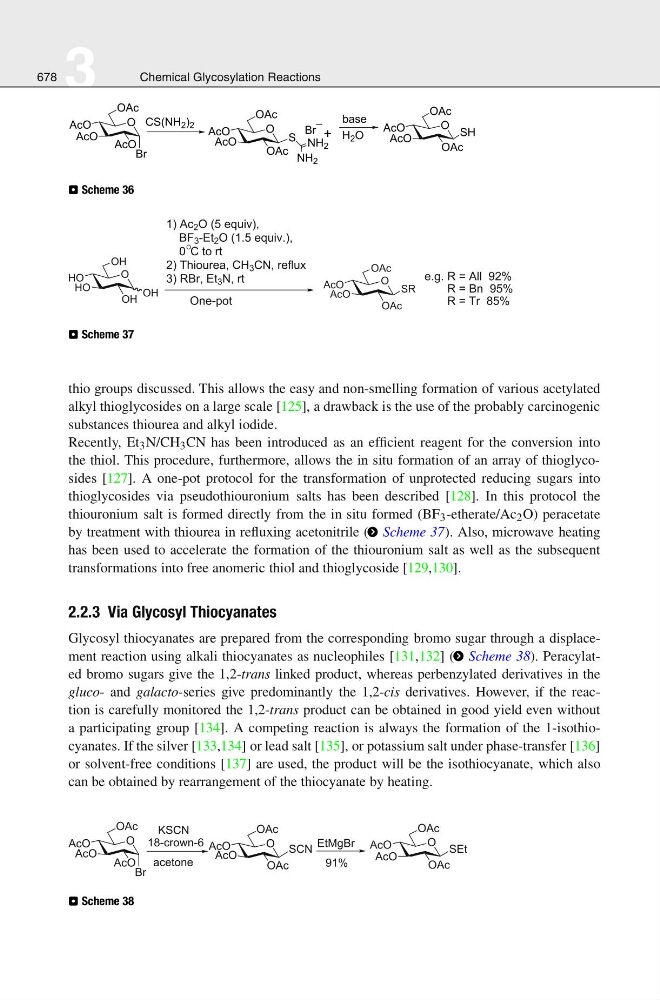
⊡ Scheme 36
⊡ Scheme 37
thio groups discussed. This allows the easy and non-smelling formation of various acetylated
alkyl thioglycosides on a large scale [125], a drawback is the use of the probably carcinogenic
substances thiourea and alkyl iodide.
Recently, Et 3 N/CH 3 CN has been introduced as an efficient reagent for the conversion into
the thiol. This procedure, furthermore, allows the in situ formation of an array of thioglycosides [127]. A one-pot protocol for the transformation of unprotected reducing sugars into
thioglycosides via pseudothiouronium salts has been described [128]. In this protocol the
thiouronium salt is formed directly from the in situ formed (BF 3 -etherate/Ac 2 O) peracetate
by treatment with thiourea in refluxing acetonitrile ( > Scheme 37). Also, microwave heating
has been used to accelerate the formation of the thiouronium salt as well as the subsequent
transformations into free anomeric thiol and thioglycoside [129,130].
2.2.3 Via Glycosyl Thiocyanates
Glycosyl thiocyanates are prepared from the corresponding bromo sugar through a displacement reaction using alkali thiocyanates as nucleophiles [131,132] ( > Scheme 38). Peracylated bromo sugars give the 1,2-trans linked product, whereas perbenzylated derivatives in the
gluco- and galacto-series give predominantly the 1,2-cis derivatives. However, if the reaction is carefully monitored the 1,2-trans product can be obtained in good yield even without
a participating group [134]. A competing reaction is always the formation of the 1-isothiocyanates. If the silver [133,134] or lead salt [135], or potassium salt under phase-transfer [136]
or solvent-free conditions [137] are used, the product will be the isothiocyanate, which also
can be obtained by rearrangement of the thiocyanate by heating.
⊡ Scheme 38