

S-Glycosylation
3.5
677
2.2 Indirect Synthesis
The second main pathway to thioglycosides involves, as mentioned in the introduction, at least
two steps: first the introduction of the anomeric sulfur using one of the ways described above,
most often displacement of an anomeric halogen or acetate with a thionucleophile to give
a 1-thio derivative, which then is directly transformed into a thioglycoside or cleaved to give
a thioaldose or its thiolate salt, which finally is alkylated ( > Scheme 2). Recently it was also
shown that anomeric thiols can be produced directly from protected hemiacetal saccharides by
treatment with Lawesson’s reagent [197]. Sometimes the uncovered thiol is protected, e. g., by
a xanthenyl [117] or a trityl [118] group, to allow various manipulations prior to re-exposure
of the thiol and eventual formation of a thioglycoside. The 1-thio precursors mainly employed
are glycosyl thioacetates, thiouronium salts, thiocyanates, and xanthates. Their syntheses, as
well as their transformations into thioglycosides, are discussed below.
2.2.1 Via Glycosyl Thioacetates
Glycosyl thioacetates are prepared from glycopyranosyl halides or acetates employing either
thioacetic acid or potassium thioacetate as reagent under various conditions as discussed
above [1,37,119]. The higher nucleophilicity of sulfur, as compared to oxygen, is evident
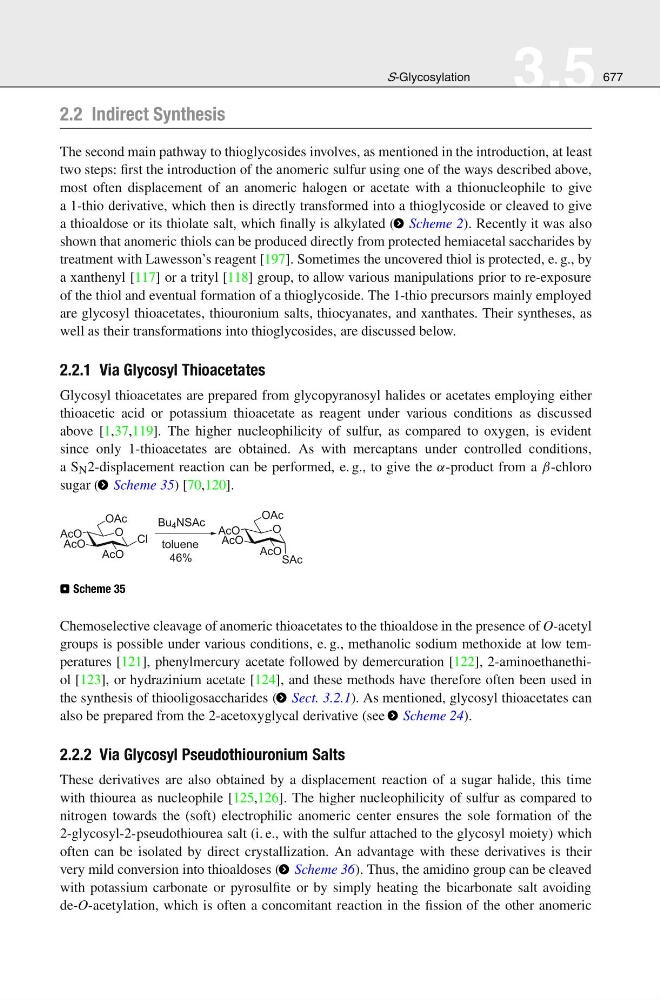
since only 1-thioacetates are obtained. As with mercaptans under controlled conditions,
a S N 2-displacement reaction can be performed, e. g., to give the α-product from a β-chloro
sugar ( > Scheme 35) [70,120].
⊡ Scheme 35
Chemoselective cleavage of anomeric thioacetates to the thioaldose in the presence of O-acetyl
groups is possible under various conditions, e. g., methanolic sodium methoxide at low temperatures [121], phenylmercury acetate followed by demercuration [122], 2-aminoethanethiol [123], or hydrazinium acetate [124], and these methods have therefore often been used in
the synthesis of thiooligosaccharides ( > Sect. 3.2.1). As mentioned, glycosyl thioacetates can
also be prepared from the 2-acetoxyglycal derivative (see > Scheme 24).
2.2.2 Via Glycosyl Pseudothiouronium Salts
These derivatives are also obtained by a displacement reaction of a sugar halide, this time
with thiourea as nucleophile [125,126]. The higher nucleophilicity of sulfur as compared to
nitrogen towards the (soft) electrophilic anomeric center ensures the sole formation of the
2-glycosyl-2-pseudothiourea salt (i. e., with the sulfur attached to the glycosyl moiety) which
often can be isolated by direct crystallization. An advantage with these derivatives is their
very mild conversion into thioaldoses ( > Scheme 36). Thus, the amidino group can be cleaved
with potassium carbonate or pyrosulfite or by simply heating the bicarbonate salt avoiding
de-O-acetylation, which is often a concomitant reaction in the fission of the other anomeric