

676
3
Chemical Glycosylation Reactions
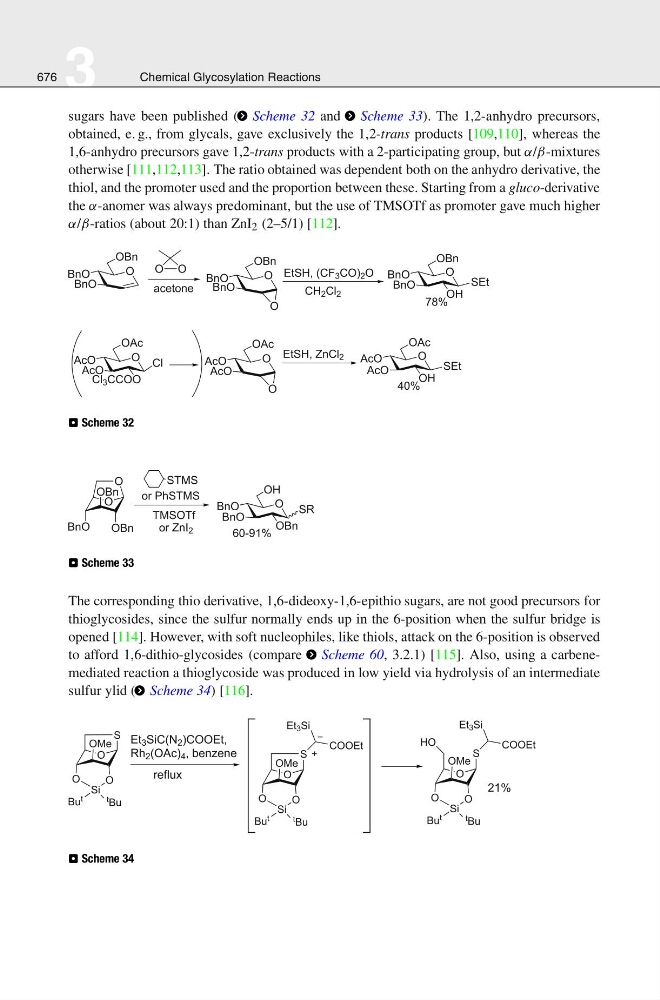
sugars have been published ( > Scheme 32 and > Scheme 33). The 1,2-anhydro precursors,
obtained, e. g., from glycals, gave exclusively the 1,2-trans products [109,110], whereas the
1,6-anhydro precursors gave 1,2-trans products with a 2-participating group, but α/β-mixtures
otherwise [111,112,113]. The ratio obtained was dependent both on the anhydro derivative, the
thiol, and the promoter used and the proportion between these. Starting from a gluco-derivative
the α-anomer was always predominant, but the use of TMSOTf as promoter gave much higher
α/β-ratios (about 20:1) than ZnI 2 (2–5/1) [112].
⊡ Scheme 32
⊡ Scheme 33
The corresponding thio derivative, 1,6-dideoxy-1,6-epithio sugars, are not good precursors for
thioglycosides, since the sulfur normally ends up in the 6-position when the sulfur bridge is
opened [114]. However, with soft nucleophiles, like thiols, attack on the 6-position is observed
to afford 1,6-dithio-glycosides (compare > Scheme 60, 3.2.1) [115]. Also, using a carbenemediated reaction a thioglycoside was produced in low yield via hydrolysis of an intermediate
sulfur ylid ( > Scheme 34) [116].
⊡ Scheme 34