

S-Glycosylation
3.5
679
The glycosyl thiocyanates can be transformed into thioglycosides through cleavage to the
thioaldose by treatment with sodium methoxide under mild conditions followed by alkylation,
or by a Grignard reaction which directly gives the thioglycoside (mannose-α-D-thiocyanate
was inert) ( > Scheme 38) [138].
2.2.4 Via Glycosyl Xanthates
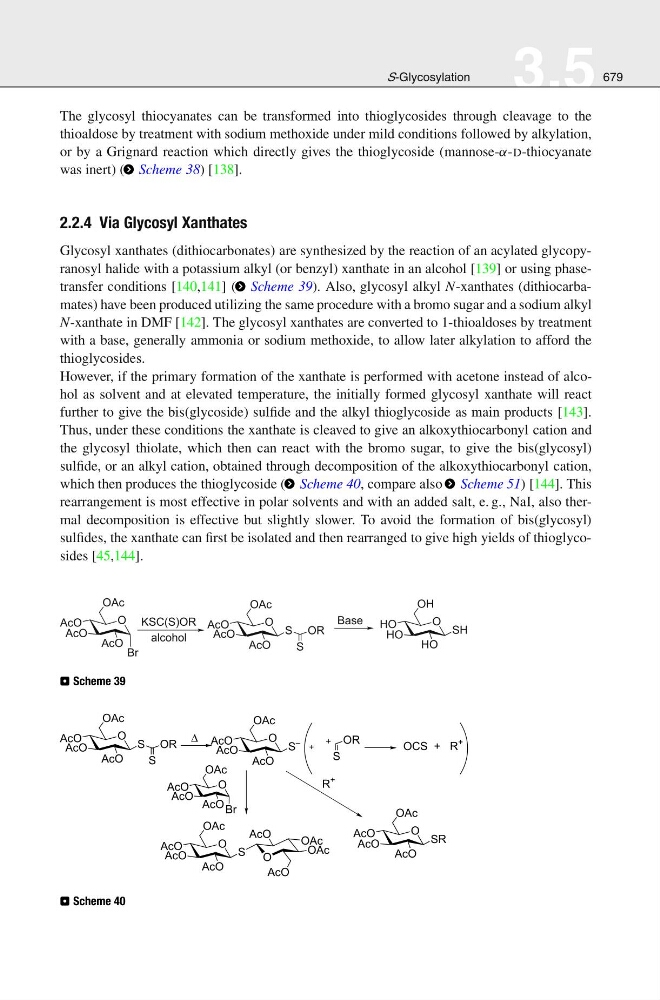
Glycosyl xanthates (dithiocarbonates) are synthesized by the reaction of an acylated glycopyranosyl halide with a potassium alkyl (or benzyl) xanthate in an alcohol [139] or using phasetransfer conditions [140,141] ( > Scheme 39). Also, glycosyl alkyl N-xanthates (dithiocarbamates) have been produced utilizing the same procedure with a bromo sugar and a sodium alkyl
N-xanthate in DMF [142]. The glycosyl xanthates are converted to 1-thioaldoses by treatment
with a base, generally ammonia or sodium methoxide, to allow later alkylation to afford the
thioglycosides.
However, if the primary formation of the xanthate is performed with acetone instead of alcohol as solvent and at elevated temperature, the initially formed glycosyl xanthate will react
further to give the bis(glycoside) sulfide and the alkyl thioglycoside as main products [143].
Thus, under these conditions the xanthate is cleaved to give an alkoxythiocarbonyl cation and
the glycosyl thiolate, which then can react with the bromo sugar, to give the bis(glycosyl)
sulfide, or an alkyl cation, obtained through decomposition of the alkoxythiocarbonyl cation,
which then produces the thioglycoside ( > Scheme 40, compare also > Scheme 51) [144]. This
rearrangement is most effective in polar solvents and with an added salt, e. g., NaI, also thermal decomposition is effective but slightly slower. To avoid the formation of bis(glycosyl)
sulfides, the xanthate can first be isolated and then rearranged to give high yields of thioglycosides [45,144].
⊡ Scheme 39
⊡ Scheme 40