

S-Glycosylation
3.5
667
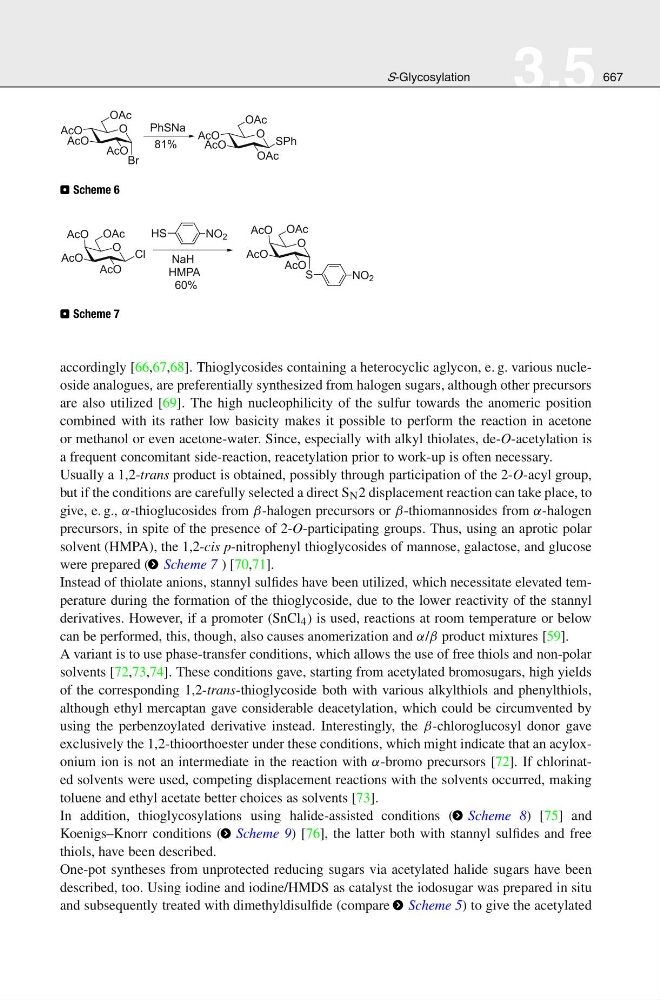
⊡ Scheme 6
⊡ Scheme 7
accordingly [66,67,68]. Thioglycosides containing a heterocyclic aglycon, e. g. various nucleoside analogues, are preferentially synthesized from halogen sugars, although other precursors
are also utilized [69]. The high nucleophilicity of the sulfur towards the anomeric position
combined with its rather low basicity makes it possible to perform the reaction in acetone
or methanol or even acetone-water. Since, especially with alkyl thiolates, de-O-acetylation is
a frequent concomitant side-reaction, reacetylation prior to work-up is often necessary.
Usually a 1,2-trans product is obtained, possibly through participation of the 2-O-acyl group,
but if the conditions are carefully selected a direct S N 2 displacement reaction can take place, to
give, e. g., α-thioglucosides from β-halogen precursors or β-thiomannosides from α-halogen
precursors, in spite of the presence of 2-O-participating groups. Thus, using an aprotic polar
solvent (HMPA), the 1,2-cis p-nitrophenyl thioglycosides of mannose, galactose, and glucose
were prepared ( > Scheme 7 ) [70,71].
Instead of thiolate anions, stannyl sulfides have been utilized, which necessitate elevated temperature during the formation of the thioglycoside, due to the lower reactivity of the stannyl
derivatives. However, if a promoter (SnCl 4 ) is used, reactions at room temperature or below
can be performed, this, though, also causes anomerization and α/β product mixtures [59].
A variant is to use phase-transfer conditions, which allows the use of free thiols and non-polar
solvents [72,73,74]. These conditions gave, starting from acetylated bromosugars, high yields
of the corresponding 1,2-trans-thioglycoside both with various alkylthiols and phenylthiols,
although ethyl mercaptan gave considerable deacetylation, which could be circumvented by
using the perbenzoylated derivative instead. Interestingly, the β-chloroglucosyl donor gave
exclusively the 1,2-thioorthoester under these conditions, which might indicate that an acyloxonium ion is not an intermediate in the reaction with α-bromo precursors [72]. If chlorinated solvents were used, competing displacement reactions with the solvents occurred, making
toluene and ethyl acetate better choices as solvents [73].
In addition, thioglycosylations using halide-assisted conditions ( > Scheme 8) [75] and
Koenigs–Knorr conditions ( > Scheme 9) [76], the latter both with stannyl sulfides and free
thiols, have been described.
One-pot syntheses from unprotected reducing sugars via acetylated halide sugars have been
described, too. Using iodine and iodine/HMDS as catalyst the iodosugar was prepared in situ
and subsequently treated with dimethyldisulfide (compare > Scheme 5) to give the acetylated