

666
3
Chemical Glycosylation Reactions
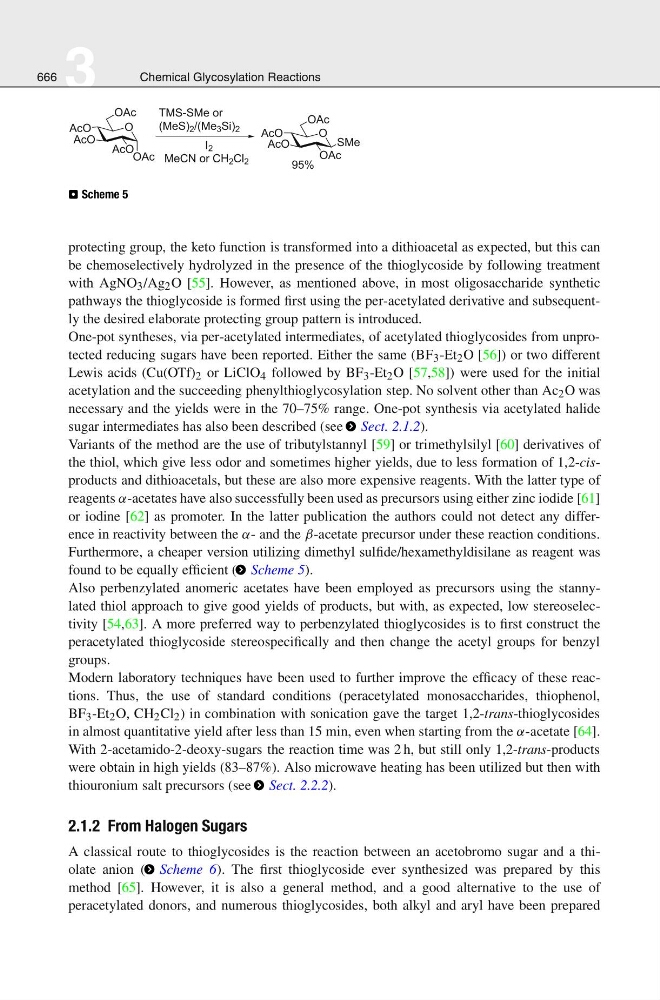
⊡ Scheme 5
protecting group, the keto function is transformed into a dithioacetal as expected, but this can
be chemoselectively hydrolyzed in the presence of the thioglycoside by following treatment
with AgNO 3 /Ag 2 O [55]. However, as mentioned above, in most oligosaccharide synthetic
pathways the thioglycoside is formed first using the per-acetylated derivative and subsequently the desired elaborate protecting group pattern is introduced.
One-pot syntheses, via per-acetylated intermediates, of acetylated thioglycosides from unprotected reducing sugars have been reported. Either the same (BF 3 -Et 2 O [56]) or two different
Lewis acids (Cu(OTf) 2 or LiClO 4 followed by BF 3 -Et 2 O [57,58]) were used for the initial
acetylation and the succeeding phenylthioglycosylation step. No solvent other than Ac 2 O was
necessary and the yields were in the 70–75% range. One-pot synthesis via acetylated halide
sugar intermediates has also been described (see > Sect. 2.1.2).
Variants of the method are the use of tributylstannyl [59] or trimethylsilyl [60] derivatives of
the thiol, which give less odor and sometimes higher yields, due to less formation of 1,2-cisproducts and dithioacetals, but these are also more expensive reagents. With the latter type of
reagents α-acetates have also successfully been used as precursors using either zinc iodide [61]
or iodine [62] as promoter. In the latter publication the authors could not detect any difference in reactivity between the α- and the β-acetate precursor under these reaction conditions.
Furthermore, a cheaper version utilizing dimethyl sulfide/hexamethyldisilane as reagent was
found to be equally efficient ( > Scheme 5).
Also perbenzylated anomeric acetates have been employed as precursors using the stannylated thiol approach to give good yields of products, but with, as expected, low stereoselectivity [54,63]. A more preferred way to perbenzylated thioglycosides is to first construct the
peracetylated thioglycoside stereospecifically and then change the acetyl groups for benzyl
groups.
Modern laboratory techniques have been used to further improve the efficacy of these reactions. Thus, the use of standard conditions (peracetylated monosaccharides, thiophenol,
BF 3 -Et 2 O, CH 2 Cl 2 ) in combination with sonication gave the target 1,2-trans-thioglycosides
in almost quantitative yield after less than 15 min, even when starting from the α-acetate [64].
With 2-acetamido-2-deoxy-sugars the reaction time was 2 h, but still only 1,2-trans-products
were obtain in high yields (83–87%). Also microwave heating has been utilized but then with
thiouronium salt precursors (see > Sect. 2.2.2).
2.1.2 From Halogen Sugars
A classical route to thioglycosides is the reaction between an acetobromo sugar and a thiolate anion ( > Scheme 6). The first thioglycoside ever synthesized was prepared by this
method [65]. However, it is also a general method, and a good alternative to the use of
peracetylated donors, and numerous thioglycosides, both alkyl and aryl have been prepared