

S-Glycosylation
3.5
665
⊡ Scheme 3
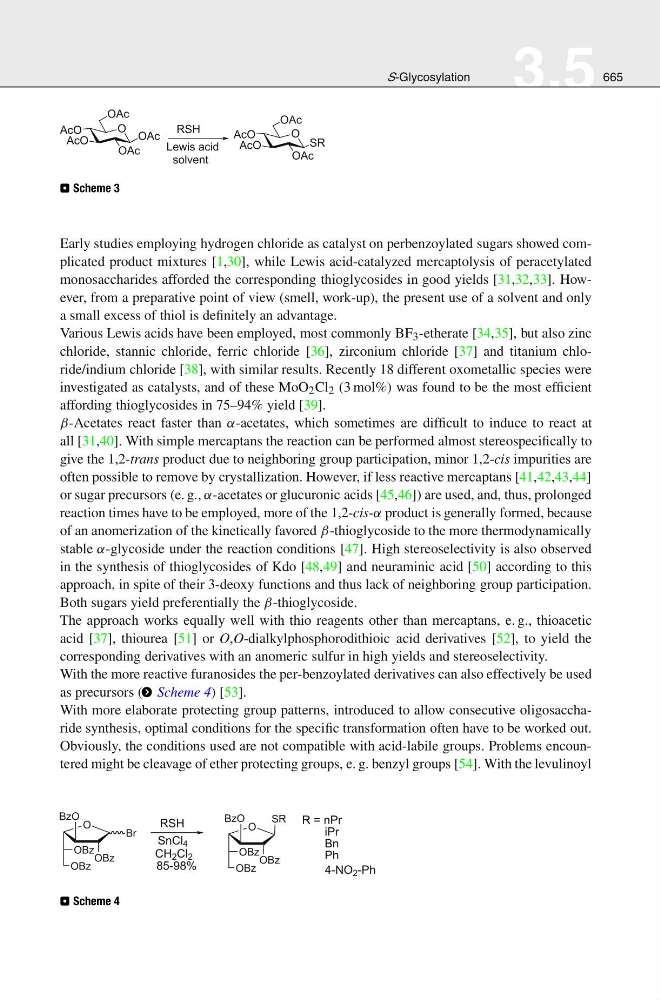
Early studies employing hydrogen chloride as catalyst on perbenzoylated sugars showed complicated product mixtures [1,30], while Lewis acid-catalyzed mercaptolysis of peracetylated
monosaccharides afforded the corresponding thioglycosides in good yields [31,32,33]. However, from a preparative point of view (smell, work-up), the present use of a solvent and only
a small excess of thiol is definitely an advantage.
Various Lewis acids have been employed, most commonly BF 3 -etherate [34,35], but also zinc
chloride, stannic chloride, ferric chloride [36], zirconium chloride [37] and titanium chloride/indium chloride [38], with similar results. Recently 18 different oxometallic species were
investigated as catalysts, and of these MoO 2 Cl 2 (3 mol%) was found to be the most efficient
affording thioglycosides in 75–94% yield [39].
β-Acetates react faster than α-acetates, which sometimes are difficult to induce to react at
all [31,40]. With simple mercaptans the reaction can be performed almost stereospecifically to
give the 1,2-trans product due to neighboring group participation, minor 1,2-cis impurities are
often possible to remove by crystallization. However, if less reactive mercaptans [41,42,43,44]
or sugar precursors (e. g., α-acetates or glucuronic acids [45,46]) are used, and, thus, prolonged
reaction times have to be employed, more of the 1,2-cis-α product is generally formed, because
of an anomerization of the kinetically favored β-thioglycoside to the more thermodynamically
stable α-glycoside under the reaction conditions [47]. High stereoselectivity is also observed
in the synthesis of thioglycosides of Kdo [48,49] and neuraminic acid [50] according to this
approach, in spite of their 3-deoxy functions and thus lack of neighboring group participation.
Both sugars yield preferentially the β-thioglycoside.
The approach works equally well with thio reagents other than mercaptans, e. g., thioacetic
acid [37], thiourea [51] or O,O-dialkylphosphorodithioic acid derivatives [52], to yield the
corresponding derivatives with an anomeric sulfur in high yields and stereoselectivity.
With the more reactive furanosides the per-benzoylated derivatives can also effectively be used
as precursors ( > Scheme 4) [53].
With more elaborate protecting group patterns, introduced to allow consecutive oligosaccharide synthesis, optimal conditions for the specific transformation often have to be worked out.
Obviously, the conditions used are not compatible with acid-labile groups. Problems encountered might be cleavage of ether protecting groups, e. g. benzyl groups [54]. With the levulinoyl
⊡ Scheme 4