

664
3
Chemical Glycosylation Reactions
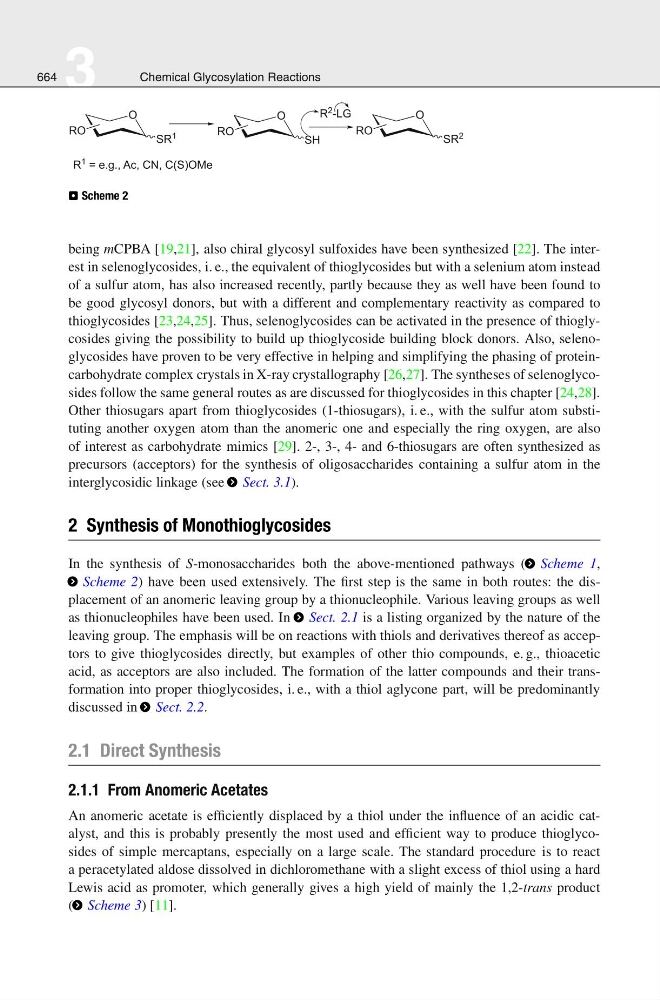
⊡ Scheme 2
being mCPBA [19,21], also chiral glycosyl sulfoxides have been synthesized [22]. The interest in selenoglycosides, i. e., the equivalent of thioglycosides but with a selenium atom instead
of a sulfur atom, has also increased recently, partly because they as well have been found to
be good glycosyl donors, but with a different and complementary reactivity as compared to
thioglycosides [23,24,25]. Thus, selenoglycosides can be activated in the presence of thioglycosides giving the possibility to build up thioglycoside building block donors. Also, selenoglycosides have proven to be very effective in helping and simplifying the phasing of proteincarbohydrate complex crystals in X-ray crystallography [26,27]. The syntheses of selenoglycosides follow the same general routes as are discussed for thioglycosides in this chapter [24,28].
Other thiosugars apart from thioglycosides (1-thiosugars), i. e., with the sulfur atom substituting another oxygen atom than the anomeric one and especially the ring oxygen, are also
of interest as carbohydrate mimics [29]. 2-, 3-, 4- and 6-thiosugars are often synthesized as
precursors (acceptors) for the synthesis of oligosaccharides containing a sulfur atom in the
interglycosidic linkage (see > Sect. 3.1).
2 Synthesis of Monothioglycosides
In the synthesis of S-monosaccharides both the above-mentioned pathways ( > Scheme 1,
> Scheme 2) have been used extensively. The first step is the same in both routes: the displacement of an anomeric leaving group by a thionucleophile. Various leaving groups as well
as thionucleophiles have been used. In > Sect. 2.1 is a listing organized by the nature of the
leaving group. The emphasis will be on reactions with thiols and derivatives thereof as acceptors to give thioglycosides directly, but examples of other thio compounds, e. g., thioacetic
acid, as acceptors are also included. The formation of the latter compounds and their transformation into proper thioglycosides, i. e., with a thiol aglycone part, will be predominantly
discussed in > Sect. 2.2.
2.1 Direct Synthesis
2.1.1 From Anomeric Acetates
An anomeric acetate is efficiently displaced by a thiol under the influence of an acidic catalyst, and this is probably presently the most used and efficient way to produce thioglycosides of simple mercaptans, especially on a large scale. The standard procedure is to react
a peracetylated aldose dissolved in dichloromethane with a slight excess of thiol using a hard
Lewis acid as promoter, which generally gives a high yield of mainly the 1,2-trans product
( > Scheme 3) [11].