

S-Glycosylation
3.5
663
ed antibiotics found in Streptomyces species [4,5,6] and quite recently the methylthiomethyl
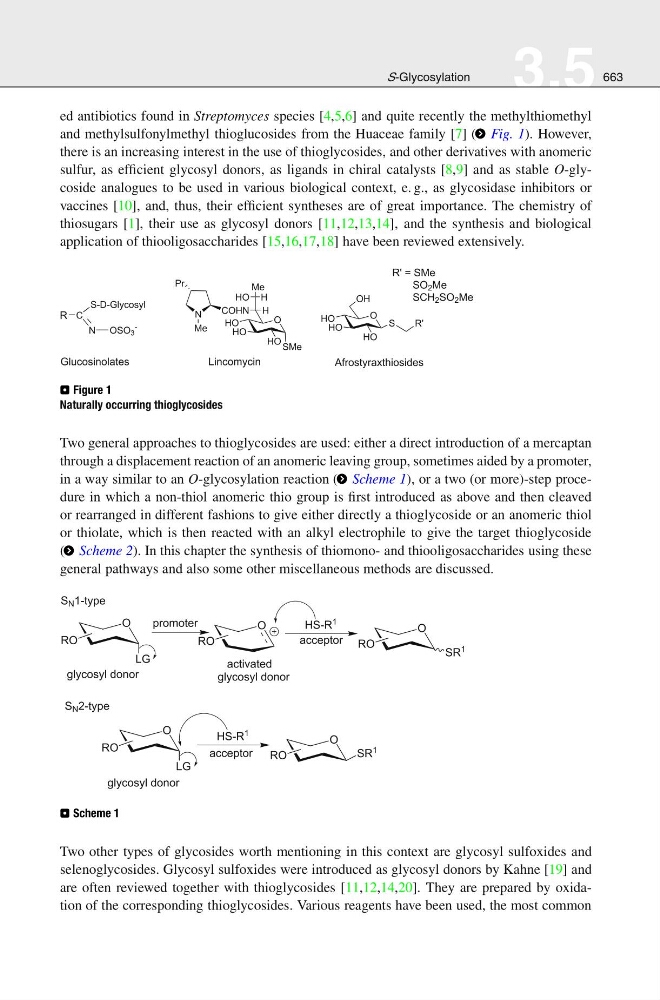
and methylsulfonylmethyl thioglucosides from the Huaceae family [7] ( > Fig. 1). However,
there is an increasing interest in the use of thioglycosides, and other derivatives with anomeric
sulfur, as efficient glycosyl donors, as ligands in chiral catalysts [8,9] and as stable O-glycoside analogues to be used in various biological context, e. g., as glycosidase inhibitors or
vaccines [10], and, thus, their efficient syntheses are of great importance. The chemistry of
thiosugars [1], their use as glycosyl donors [11,12,13,14], and the synthesis and biological
application of thiooligosaccharides [15,16,17,18] have been reviewed extensively.
⊡ Figure 1
Naturally occurring thioglycosides
Two general approaches to thioglycosides are used: either a direct introduction of a mercaptan
through a displacement reaction of an anomeric leaving group, sometimes aided by a promoter,
in a way similar to an O-glycosylation reaction ( > Scheme 1), or a two (or more)-step procedure in which a non-thiol anomeric thio group is first introduced as above and then cleaved
or rearranged in different fashions to give either directly a thioglycoside or an anomeric thiol
or thiolate, which is then reacted with an alkyl electrophile to give the target thioglycoside
( > Scheme 2). In this chapter the synthesis of thiomono- and thiooligosaccharides using these
general pathways and also some other miscellaneous methods are discussed.
⊡ Scheme 1
Two other types of glycosides worth mentioning in this context are glycosyl sulfoxides and
selenoglycosides. Glycosyl sulfoxides were introduced as glycosyl donors by Kahne [19] and
are often reviewed together with thioglycosides [11,12,14,20]. They are prepared by oxidation of the corresponding thioglycosides. Various reagents have been used, the most common