

668
3
Chemical Glycosylation Reactions
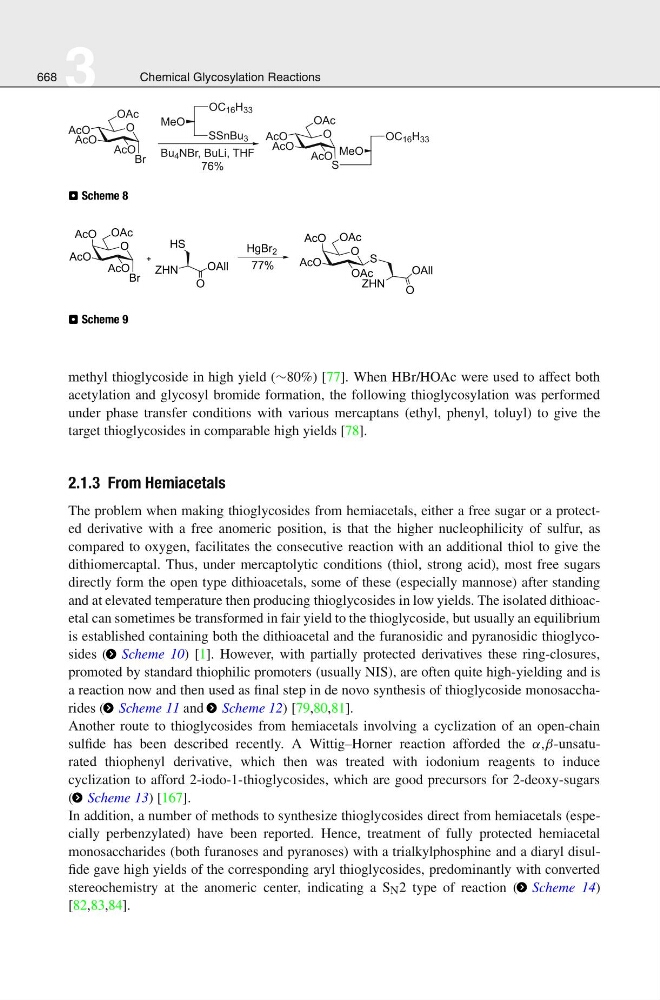
⊡ Scheme 8
⊡ Scheme 9
methyl thioglycoside in high yield (∼80%) [77]. When HBr/HOAc were used to affect both
acetylation and glycosyl bromide formation, the following thioglycosylation was performed
under phase transfer conditions with various mercaptans (ethyl, phenyl, toluyl) to give the
target thioglycosides in comparable high yields [78].
2.1.3 From Hemiacetals
The problem when making thioglycosides from hemiacetals, either a free sugar or a protected derivative with a free anomeric position, is that the higher nucleophilicity of sulfur, as
compared to oxygen, facilitates the consecutive reaction with an additional thiol to give the
dithiomercaptal. Thus, under mercaptolytic conditions (thiol, strong acid), most free sugars
directly form the open type dithioacetals, some of these (especially mannose) after standing
and at elevated temperature then producing thioglycosides in low yields. The isolated dithioacetal can sometimes be transformed in fair yield to the thioglycoside, but usually an equilibrium
is established containing both the dithioacetal and the furanosidic and pyranosidic thioglycosides ( > Scheme 10) [1]. However, with partially protected derivatives these ring-closures,
promoted by standard thiophilic promoters (usually NIS), are often quite high-yielding and is
a reaction now and then used as final step in de novo synthesis of thioglycoside monosaccharides ( > Scheme 11 and > Scheme 12) [79,80,81].
Another route to thioglycosides from hemiacetals involving a cyclization of an open-chain
sulfide has been described recently. A Wittig–Horner reaction afforded the α,β-unsaturated thiophenyl derivative, which then was treated with iodonium reagents to induce
cyclization to afford 2-iodo-1-thioglycosides, which are good precursors for 2-deoxy-sugars
( > Scheme 13) [167].
In addition, a number of methods to synthesize thioglycosides direct from hemiacetals (especially perbenzylated) have been reported. Hence, treatment of fully protected hemiacetal
monosaccharides (both furanoses and pyranoses) with a trialkylphosphine and a diaryl disulfide gave high yields of the corresponding aryl thioglycosides, predominantly with converted
stereochemistry at the anomeric center, indicating a S N 2 type of reaction ( > Scheme 14)
[82,83,84].