

634
3
Chemical Glycosylation Reactions
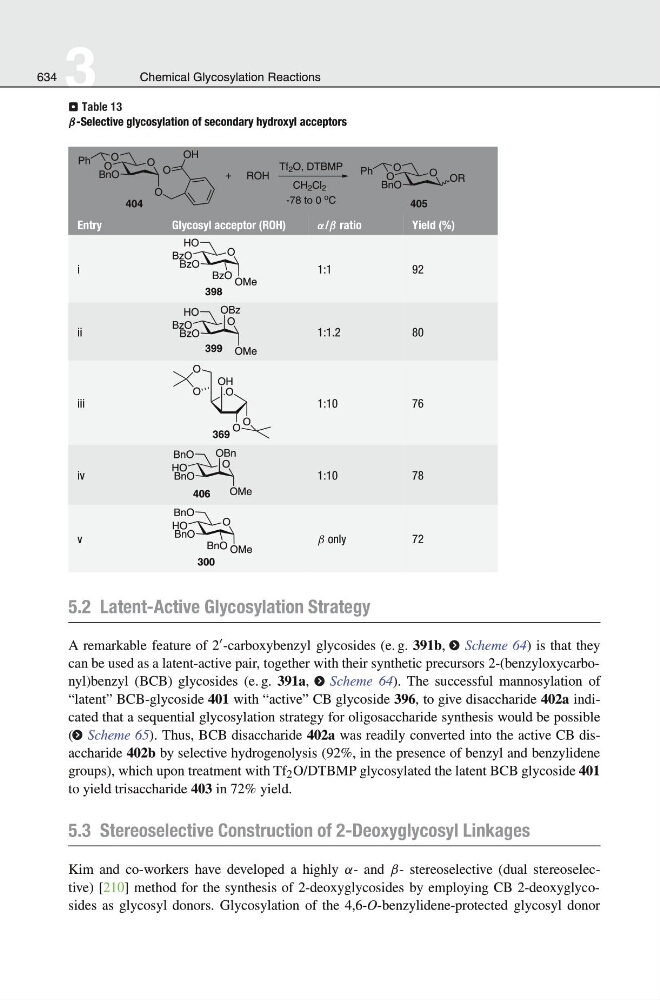
⊡ Table 13
β-Selective glycosylation of secondary hydroxyl acceptors
Entry
Glycosyl acceptor (ROH)
α/β ratio
Yield (%)
i
1:1
92
ii
1:1.2
80
iii
1:10
76
iv
1:10
78
v
β only
72
5.2 Latent-Active Glycosylation Strategy
A remarkable feature of 2 -carboxybenzyl glycosides (e. g. 391b, > Scheme 64) is that they
can be used as a latent-active pair, together with their synthetic precursors 2-(benzyloxycarbonyl)benzyl (BCB) glycosides (e. g. 391a, > Scheme 64). The successful mannosylation of
“latent” BCB-glycoside 401 with “active” CB glycoside 396, to give disaccharide 402a indicated that a sequential glycosylation strategy for oligosaccharide synthesis would be possible
( > Scheme 65). Thus, BCB disaccharide 402a was readily converted into the active CB disaccharide 402b by selective hydrogenolysis (92%, in the presence of benzyl and benzylidene
groups), which upon treatment with Tf 2 O/DTBMP glycosylated the latent BCB glycoside 401
to yield trisaccharide 403 in 72% yield.
5.3 Stereoselective Construction of 2-Deoxyglycosyl Linkages
Kim and co-workers have developed a highly α- and β- stereoselective (dual stereoselective) [210] method for the synthesis of 2-deoxyglycosides by employing CB 2-deoxyglycosides as glycosyl donors. Glycosylation of the 4,6-O-benzylidene-protected glycosyl donor