

O-Glycosyl Donors
3.4
633
of 2-(benzyloxycarbonyl)benzyl (BCB) glycosides, 391a [201,202,203]. Lactonization of the
glycosyl triflate 392, which was derived from the CB glycoside 391b, is the driving force
for the facile generation of the oxocarbenium ion 394 ( > Scheme 64). Reaction of 394 with
the glycosyl acceptor (Sugar–OH) would give the desired saccharide 395. In the course of
the transformation, a non-nucleophilic phthalide 393 is extruded. Treatment of CB glycosides
with Tf 2 O in the presence of di-tert-butylmethylpyridine (DTBMP) at −78 °C and subsequent
addition of the glycosyl acceptor afforded the expected disaccharides in excellent yields.
5.1 β-D-Mannosylation Employing 2 -Carboxybenzyl Glycosyl Donors
The stereospecific formation of β-mannopyranosyl linkages is a challenging task in oligosaccharide synthesis [204]. Crich and co-workers found that 4,6-O-benzylidene-protected glycosyl sulfoxides or thioglycosides are useful donors in the construction of β-mannopyranosyl
linkages [205,206,207,208,209]. Kim and co-workers have shown that CB glycosides with
a 4,6-benzylidene group can also be applied for stereoselective β-mannopyranosylation. Glycosylations of primary alcohol acceptors, 398 and 399, in CH 2 Cl 2 were completed in 1 h at
−78 °C to afford only β-mannosides in high yields ( > Table 12 entries i, iii). Toluene was also
found to be a good solvent ( > Table 12, entry ii). This high β-selective mannosylation was
also achieved with secondary alcohols, e. g. 369, 400, and with hindered tertiary alcohol 129
( > Table 12, entries iv–vi). Glucosyl CB donors possessing the 4,6-benzylidene group gave
high yields of α-glucosides.
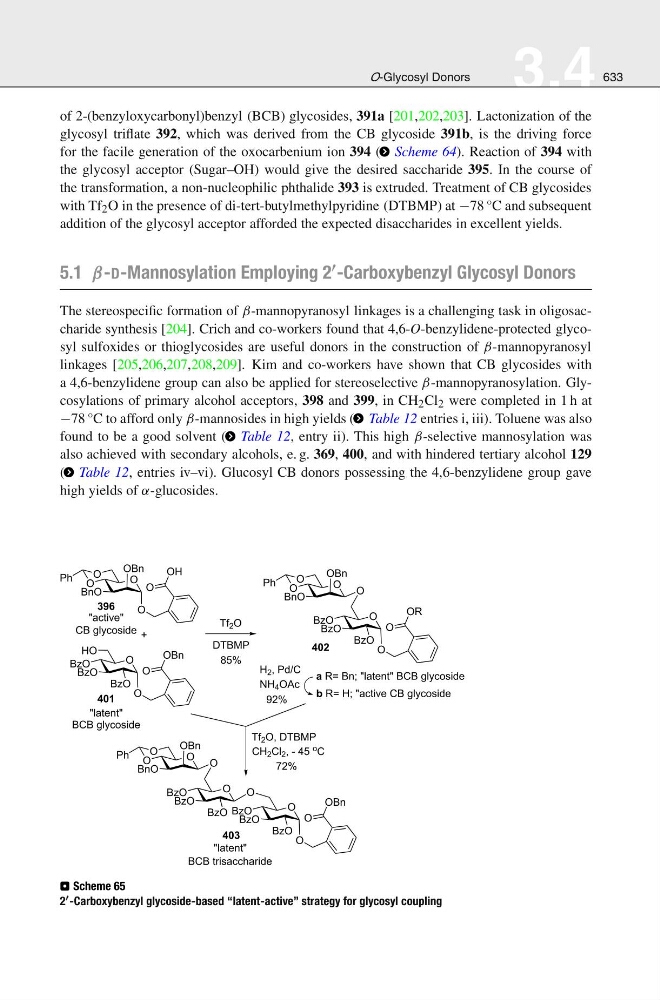
⊡ Scheme 65
2 -Carboxybenzyl glycoside-based “latent-active” strategy for glycosyl coupling