

O-Glycosyl Donors
3.4
635
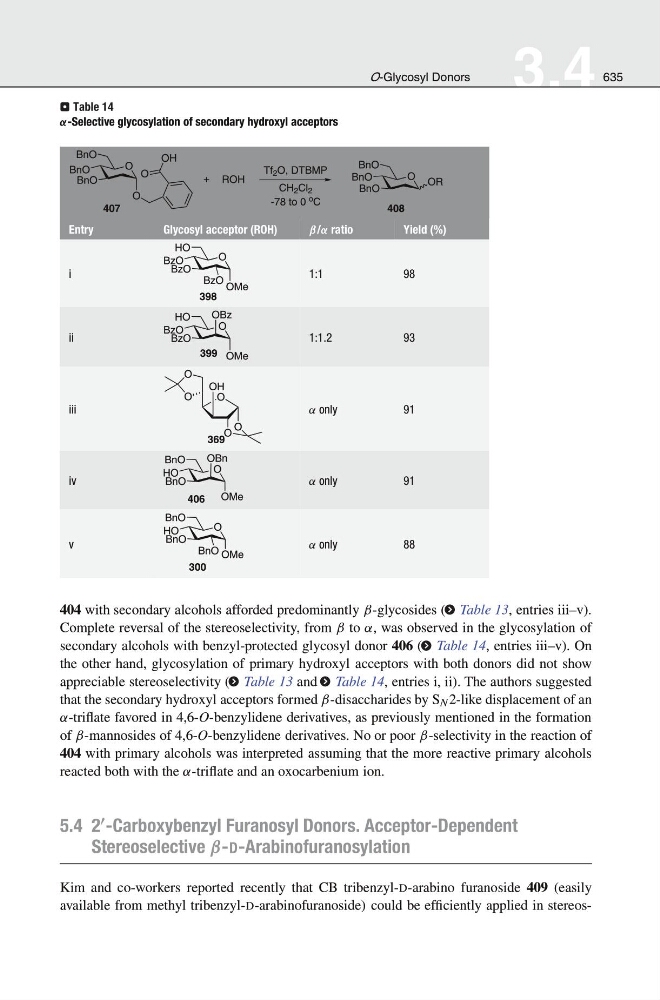
⊡ Table 14
α-Selective glycosylation of secondary hydroxyl acceptors
Entry
Glycosyl acceptor (ROH)
β/α ratio
Yield (%)
i
1:1
98
ii
1:1.2
93
iii
α only
91
iv
α only
91
v
α only
88
404 with secondary alcohols afforded predominantly β-glycosides ( > Table 13, entries iii–v).
Complete reversal of the stereoselectivity, from β to α, was observed in the glycosylation of
secondary alcohols with benzyl-protected glycosyl donor 406 ( > Table 14, entries iii–v). On
the other hand, glycosylation of primary hydroxyl acceptors with both donors did not show
appreciable stereoselectivity ( > Table 13 and > Table 14, entries i, ii). The authors suggested
that the secondary hydroxyl acceptors formed β-disaccharides by S N 2-like displacement of an
α-triflate favored in 4,6-O-benzylidene derivatives, as previously mentioned in the formation
of β-mannosides of 4,6-O-benzylidene derivatives. No or poor β-selectivity in the reaction of
404 with primary alcohols was interpreted assuming that the more reactive primary alcohols
reacted both with the α-triflate and an oxocarbenium ion.
5.4 2 -Carboxybenzyl Furanosyl Donors. Acceptor-Dependent
Stereoselective β-D-Arabinofuranosylation
Kim and co-workers reported recently that CB tribenzyl-D-arabino furanoside 409 (easily
available from methyl tribenzyl-D-arabinofuranoside) could be efficiently applied in stereos-