

O-Glycosyl Donors
3.4
611
2.11.7 Miscellaneous
Arasappan and Fraser-Reid reported an NPG-based methodology for the stereoselective construction of the tetrasaccharyl cap portion of Leishmania Lipophosphoglycan [135].
Kuzuhara and co-workers have reported the use of a NPG disaccharidic synthon as the
chain elongating unit in the synthesis of amphiphilic chitopentaose and chitoheptaose derivatives [136].
Toshida and co-workers have described the synthesis of a set of di- and tri-sulfated galabioses
by using an n-pentenyl galactoside donor and IDCP as the catalyst [137].
2.12 NPGs in Solid-Phase Oligosaccharide Synthesis
Solid-phase oligosaccharide synthesis has received considerable attention in the last years
[138]. Some of the approaches that involve NPGs are discussed below.
2.12.1 Glycosylation of Supported Alcohol Acceptors with NPG Donors
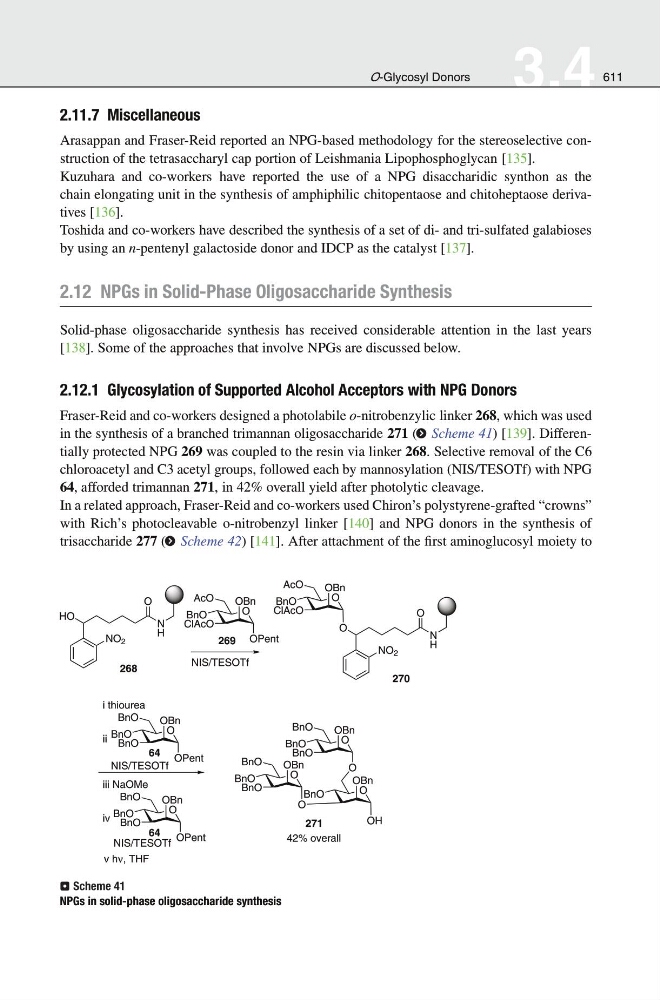
Fraser-Reid and co-workers designed a photolabile o-nitrobenzylic linker 268, which was used
in the synthesis of a branched trimannan oligosaccharide 271 ( > Scheme 41) [139]. Differentially protected NPG 269 was coupled to the resin via linker 268. Selective removal of the C6
chloroacetyl and C3 acetyl groups, followed each by mannosylation (NIS/TESOTf) with NPG
64, afforded trimannan 271, in 42% overall yield after photolytic cleavage.
In a related approach, Fraser-Reid and co-workers used Chiron’s polystyrene-grafted “crowns”
with Rich’s photocleavable o-nitrobenzyl linker [140] and NPG donors in the synthesis of
trisaccharide 277 ( > Scheme 42) [141]. After attachment of the first aminoglucosyl moiety to
⊡ Scheme 41
NPGs in solid-phase oligosaccharide synthesis