

612
3
Chemical Glycosylation Reactions
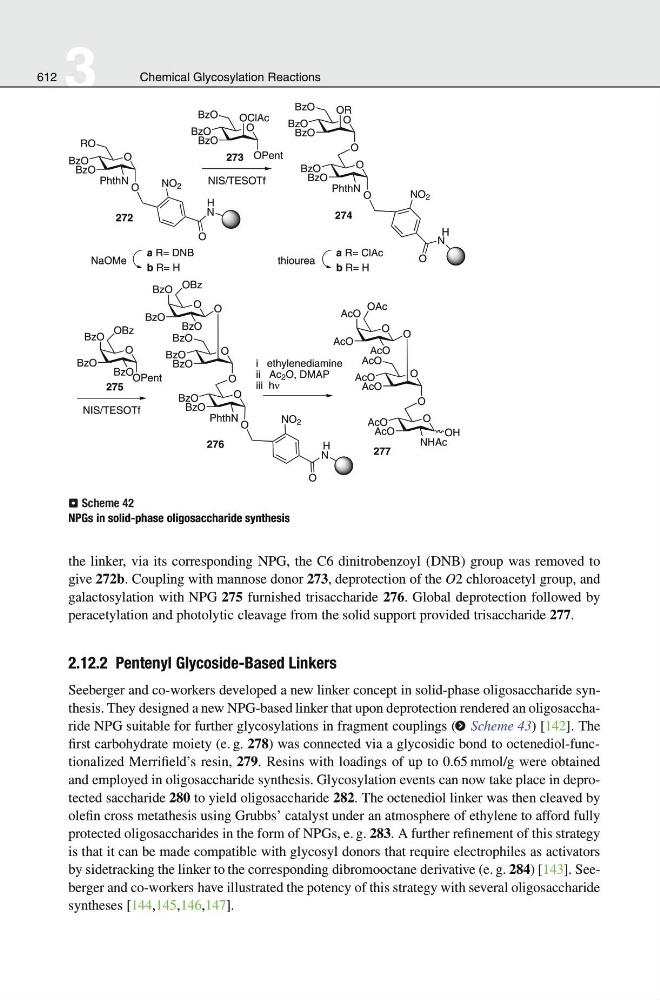
⊡ Scheme 42
NPGs in solid-phase oligosaccharide synthesis
the linker, via its corresponding NPG, the C6 dinitrobenzoyl (DNB) group was removed to
give 272b. Coupling with mannose donor 273, deprotection of the O2 chloroacetyl group, and
galactosylation with NPG 275 furnished trisaccharide 276. Global deprotection followed by
peracetylation and photolytic cleavage from the solid support provided trisaccharide 277.
2.12.2 Pentenyl Glycoside-Based Linkers
Seeberger and co-workers developed a new linker concept in solid-phase oligosaccharide synthesis. They designed a new NPG-based linker that upon deprotection rendered an oligosaccharide NPG suitable for further glycosylations in fragment couplings ( > Scheme 43) [142]. The
first carbohydrate moiety (e. g. 278) was connected via a glycosidic bond to octenediol-functionalized Merrifield’s resin, 279. Resins with loadings of up to 0.65 mmol/g were obtained
and employed in oligosaccharide synthesis. Glycosylation events can now take place in deprotected saccharide 280 to yield oligosaccharide 282. The octenediol linker was then cleaved by
olefin cross metathesis using Grubbs’ catalyst under an atmosphere of ethylene to afford fully
protected oligosaccharides in the form of NPGs, e. g. 283. A further refinement of this strategy
is that it can be made compatible with glycosyl donors that require electrophiles as activators
by sidetracking the linker to the corresponding dibromooctane derivative (e. g. 284) [143]. Seeberger and co-workers have illustrated the potency of this strategy with several oligosaccharide
syntheses [144,145,146,147].