

610
3
Chemical Glycosylation Reactions
repeating unit. p-Methoxyphenyl (PMP) and acetyl groups were used as protecting groups.
The methodology was then based on the repeated coupling of galactose donors onto galactose
acceptors followed by deprotection at O6, as in 259, which permitted the oxidation of these
primary positions to either the carboxylic acids or methyl esters.
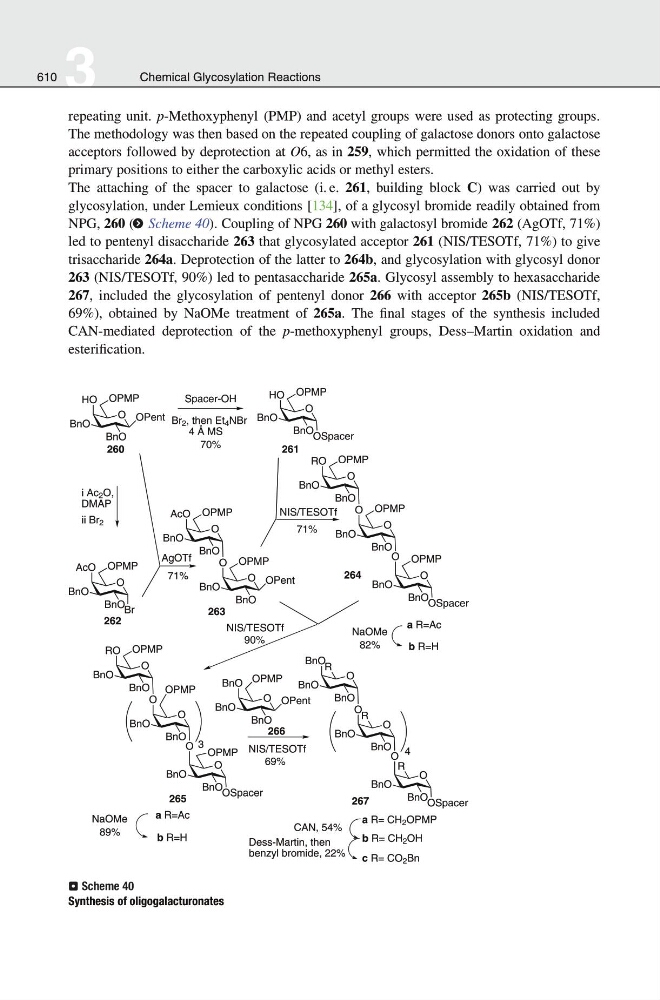
The attaching of the spacer to galactose (i. e. 261, building block C) was carried out by
glycosylation, under Lemieux conditions [134], of a glycosyl bromide readily obtained from
NPG, 260 ( > Scheme 40). Coupling of NPG 260 with galactosyl bromide 262 (AgOTf, 71%)
led to pentenyl disaccharide 263 that glycosylated acceptor 261 (NIS/TESOTf, 71%) to give
trisaccharide 264a. Deprotection of the latter to 264b, and glycosylation with glycosyl donor
263 (NIS/TESOTf, 90%) led to pentasaccharide 265a. Glycosyl assembly to hexasaccharide
267, included the glycosylation of pentenyl donor 266 with acceptor 265b (NIS/TESOTf,
69%), obtained by NaOMe treatment of 265a. The final stages of the synthesis included
CAN-mediated deprotection of the p-methoxyphenyl groups, Dess–Martin oxidation and
esterification.
⊡ Scheme 40
Synthesis of oligogalacturonates