

O-Glycosyl Donors
3.4
609
dipeptide 255, and a pentenyl trisaccharide donor 257. The key steps were the creation of the
glycosidic linkage between the trisaccharide donor 257, and the 6-deoxy-L-talose unit 255
(IDCP, 60% yield), and the final coupling of the two glycopeptide fragments. Other pentenyl
mediated couplings were the glycosylation of orthoester 253 leading to 254 (NIS/TMSOTf,
81%) and the stereoselective α-coupling of disarmed NPG 256 to give glycodipeptide 255
(NIS/TMSOTf, 70%).
2.11.6 Synthesis of Oligogalacturonates Based on NPGs
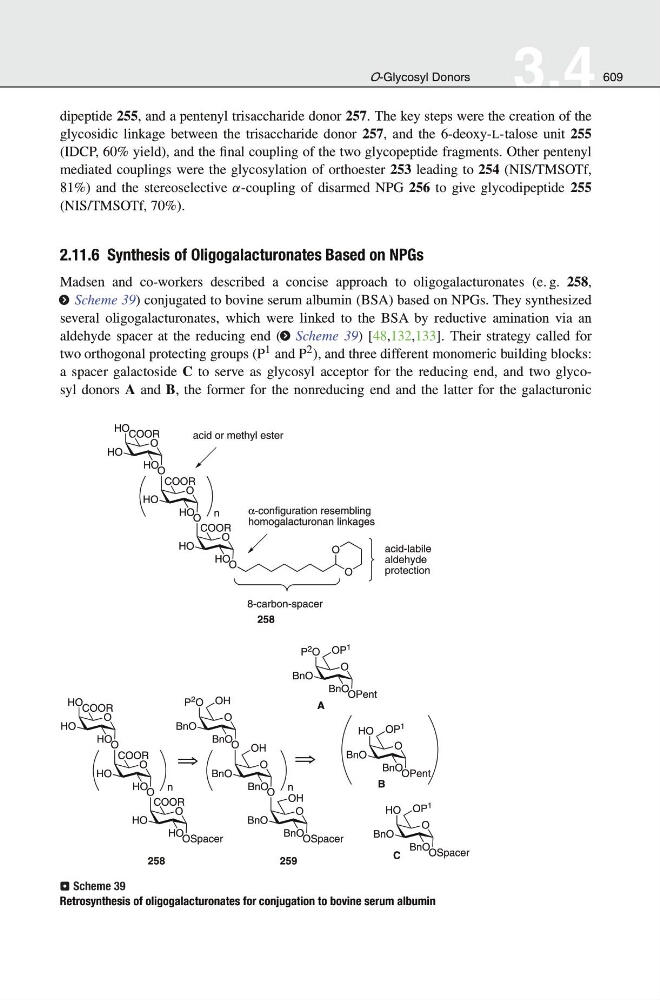
Madsen and co-workers described a concise approach to oligogalacturonates (e. g. 258,
> Scheme 39) conjugated to bovine serum albumin (BSA) based on NPGs. They synthesized
several oligogalacturonates, which were linked to the BSA by reductive amination via an
aldehyde spacer at the reducing end ( > Scheme 39) [48,132,133]. Their strategy called for
two orthogonal protecting groups (P 1 and P 2 ), and three different monomeric building blocks:
a spacer galactoside C to serve as glycosyl acceptor for the reducing end, and two glycosyl donors A and B, the former for the nonreducing end and the latter for the galacturonic
⊡ Scheme 39
Retrosynthesis of oligogalacturonates for conjugation to bovine serum albumin