

608
3
Chemical Glycosylation Reactions
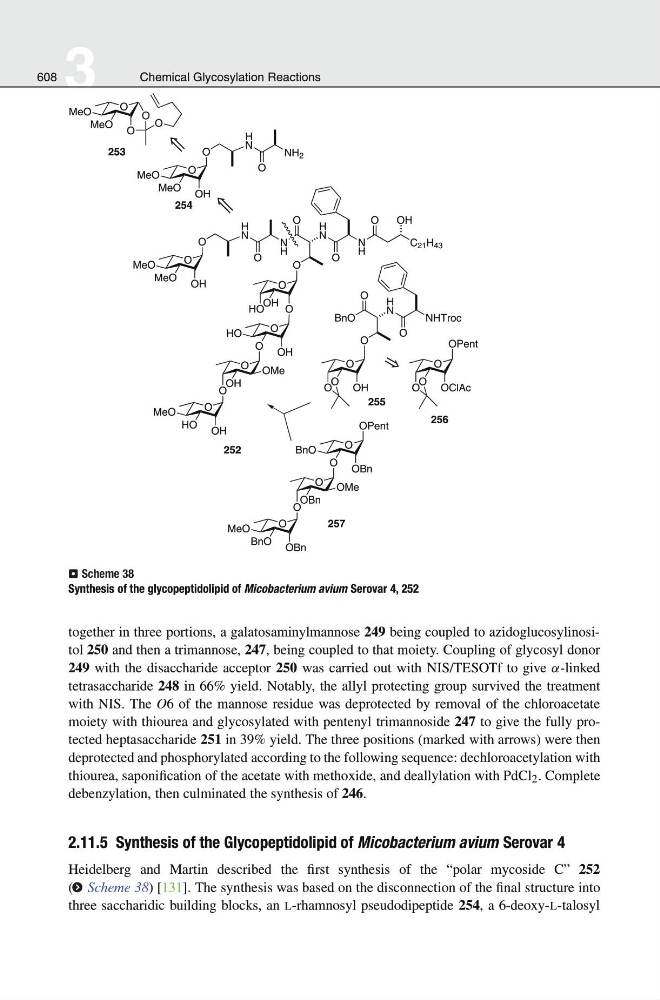
⊡ Scheme 38
Synthesis of the glycopeptidolipid of Micobacterium avium Serovar 4, 252
together in three portions, a galatosaminylmannose 249 being coupled to azidoglucosylinositol 250 and then a trimannose, 247, being coupled to that moiety. Coupling of glycosyl donor
249 with the disaccharide acceptor 250 was carried out with NIS/TESOTf to give α-linked
tetrasaccharide 248 in 66% yield. Notably, the allyl protecting group survived the treatment
with NIS. The O6 of the mannose residue was deprotected by removal of the chloroacetate
moiety with thiourea and glycosylated with pentenyl trimannoside 247 to give the fully protected heptasaccharide 251 in 39% yield. The three positions (marked with arrows) were then
deprotected and phosphorylated according to the following sequence: dechloroacetylation with
thiourea, saponification of the acetate with methoxide, and deallylation with PdCl 2 . Complete
debenzylation, then culminated the synthesis of 246.
2.11.5 Synthesis of the Glycopeptidolipid of Micobacterium avium Serovar 4
Heidelberg and Martin described the first synthesis of the “polar mycoside C” 252
( > Scheme 38) [131]. The synthesis was based on the disconnection of the final structure into
three saccharidic building blocks, an L-rhamnosyl pseudodipeptide 254, a 6-deoxy-L-talosyl